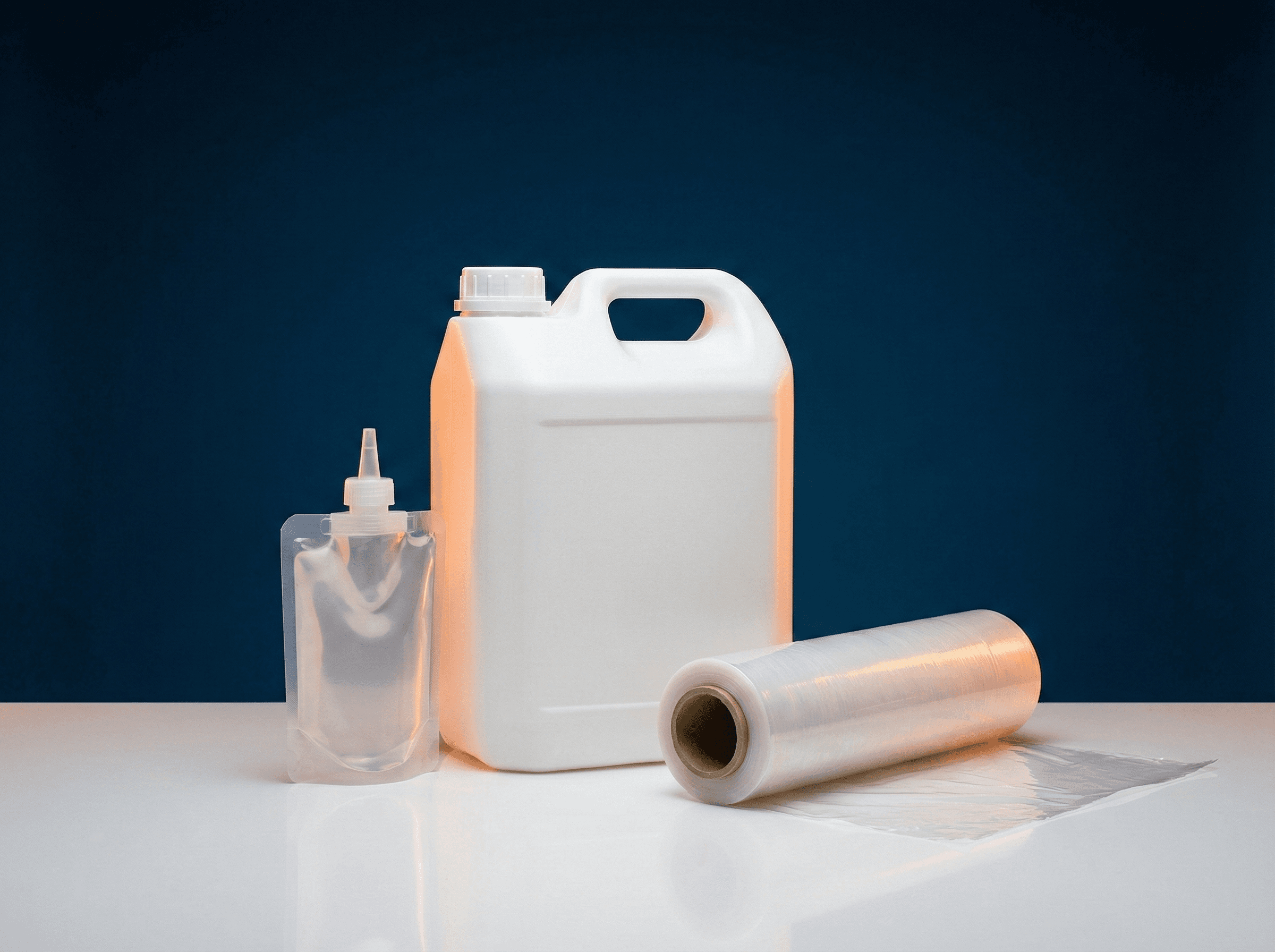
Key Benefits
- High chemical and moisture resistance
- Excellent mechanical performance
- Easy processing (extrusion, injection, blow molding)
- Multiple grades available
- Suitable for food-contact applications (depending on grade)
Resin Portfolio
Syntex America offers a complete portfolio of PE resins — HDPE, metallocene (mLLDPE) and conventional LLDPE, and LDPE — for blown and cast film, blow moulding, injection, PE100/PE80 pipe, filament, rotomoulding and extrusion coating, with grades from ExxonMobil, SABIC, Dow, NOVA, SCGC, Chevron Phillips, BASF, SIDPEC, Sinopec, Hengli, ZPC, Wanhua and more.
HDPE — High-Density Polyethylene
Rigid, strong, and durable.
Applications: bottles, jerricans, industrial containers, grocery bags, FFS packaging, pipes.
| Grade | Manufacturer | MFI (g/10 min) | Density (g/cm³) | Application | Actions |
|---|---|---|---|---|---|
| 5502BM | Petkim Petrokimya Holding | 0.35 g/10 min @ 230 °C / 2.16 kg | 0.954 g/cm³ | Blow moulding — HDPE bottles, jerricans, and industrial containers | |
| E924 | Formosa Plastics Corporation U.S.A. | 0.04 g/10 min @ 190 °C / 2.16 kg | 0.949 g/cm³ | Blown film extrusion — heavy-duty bags, shrink film, FFS packaging | |
| H5604F | SCGC™ | 0.04 g/10 min @ 190 °C / 2.16 kg | 0.954 g/cm³ | Blown film extrusion — high-strength HDPE film, T-shirt and grocery bags | |
| HF49007 | Chevron Phillips Chemical | 0.06 g/10 min @ 190 °C / 2.16 kg | 0.950 g/cm³ | Blown film extrusion — high-clarity HDPE film, FFS bags, lamination | |
| F 6095 | BASF — Easiplas® | 10.5 g/10 min @ 190 °C / 21.6 kg | 0.952 g/cm³ | Film / blow / non-pressure pipe — bags, sacks, jerry cans, liners | |
| HD 5403 EA | Sidi Kerir Petrochemicals (SIDPEC) — Egyptene | 0.35 g/10 min @ 190 °C / 2.16 kg | 0.955 g/cm³ | Blow moulding — containers up to 30 L for chemicals; household products | |
| HD 6070 UA | Sidi Kerir Petrochemicals (SIDPEC) — Egyptene | 7.5 g/10 min @ 190 °C / 2.16 kg | 0.960 g/cm³ | Injection moulding — crates, boxes, seats, pallets | |
| TR144 | Sinopec | 0.19 g/10 min @ 190 °C / 2.16 kg | 0.945 g/cm³ | Blown film extrusion — product and shopping bags | |
| HD55110 | Sinopec | 0.24 g/10 min @ 190 °C / 5 kg | 0.955 g/cm³ | Blown film extrusion — product and shopping bags | |
| ZH6098 | Sinopec | 0.65 g/10 min @ 190 °C / 5 kg | 0.948 g/cm³ | Blown film extrusion — product and shopping bags | |
| TR400N | Sinopec | 12 g/10 min @ 190 °C / 21.6 kg | 0.939 g/cm³ | Blown film extrusion — geomembrane | |
| HD5502 | Sinopec | 0.35 g/10 min @ 190 °C / 2.16 kg | 0.955 g/cm³ | Blow moulding — small containers | |
| ZH5502H | Sinopec | 0.25 g/10 min @ 190 °C / 2.16 kg | 0.955 g/cm³ | Blow moulding — small containers | |
| TR571N | Sinopec | 2.3 g/10 min @ 190 °C / 21.6 kg | 0.953 g/cm³ | Blow moulding — large containers | |
| 1158P | Sinopec | 1.85 g/10 min @ 190 °C / 21.6 kg | 0.950 g/cm³ | Blow moulding — large containers | |
| HXB4505N | Sinopec | 6 g/10 min @ 190 °C / 21.6 kg | 0.945 g/cm³ | Blow moulding — car fuel tanks | |
| PN049-030-122 | Sinopec | 0.24 g/10 min @ 190 °C / 2.16 kg | 0.950 g/cm³ | Pressure pipe — PE 100 natural | |
| YGH041 | Sinopec | 1 g/10 min @ 190 °C / 2.16 kg | 0.950 g/cm³ | Pressure pipe — PE 100 natural | |
| YGH041T | Sinopec | 0.35 g/10 min @ 190 °C / 2.16 kg | 0.960 g/cm³ | Pressure pipe — PE 100 black | |
| 2480 | Sinopec | 0.46 g/10 min @ 190 °C / 5 kg | 0.945 g/cm³ | Pressure pipe — PE 80 natural | |
| 5000S | Sinopec | 1 g/10 min @ 190 °C / 2.16 kg | 0.951 g/cm³ | HDPE filament/yarn — nets and ropes | |
| DGDA6094 | Sinopec | 1 g/10 min @ 190 °C / 2.16 kg | 0.950 g/cm³ | HDPE filament/yarn — nets and ropes | |
| HS GC 7260 | Hengli Petrochemical | 7.5 g/10 min @ 190 °C / 2.16 kg(23 g/10 min @ 190 °C / 5 kg) | — | Low-pressure injection moulding — turnover boxes | |
| GF 7750 M2 | Hengli Petrochemical | 1.1 g/10 min @ 190 °C / 2.16 kg(3.3 g/10 min @ 190 °C / 5 kg) | — | Filament / yarn — ropes, fishing nets, geotextiles | |
| 5000S (Hengli) | Hengli Petrochemical | 1.1 g/10 min @ 190 °C / 2.16 kg(3.3 g/10 min @ 190 °C / 5 kg) | — | Filament / yarn — nets, ropes | |
| 23050 | Hengli Petrochemical | 0.23 g/10 min @ 190 °C / 2.16 kg | — | Pipe extrusion — PE 100 pressure pipe | |
| ACP 5831D | Hengli Petrochemical | 1.2 g/10 min @ 190 °C / 2.16 kg | — | Blow moulding — toys, bottles, packaging |
ASTM, ISO and GB test methods are cited per the producer technical datasheets. This HDPE section spans blown film, blow moulding, injection, PE100/PE80 pipe and filament grades; NCM tariff classification 3901.20 applies to the HDPE family. Values shown as — are pending the producer datasheet, provided at order.
LLDPE — Linear Low-Density Polyethylene
High toughness and puncture resistance.
Applications: stretch film, FFS bags, heavy-duty sacks, frozen-food packaging, lamination, squeeze bottles.
| Grade | Manufacturer | MFI (g/10 min) | Density (g/cm³) | Application | Actions |
|---|---|---|---|---|---|
| 2645G | Dow | 0.9 g/10 min @ 190 °C / 2.16 kg | 0.919 g/cm³ | Blown film extrusion — heavy-duty bags, stretch film, lamination | |
| FP120-A | NOVA Chemicals | 1.0 g/10 min @ 190 °C / 2.16 kg | 0.920 g/cm³ | Blown film extrusion — heavy-duty shipping sacks, FFS, industrial liners | |
| HJ016364 | INEOS Olefins & Polymers | 2.0 g/10 min @ 230 °C / 2.16 kg | 0.918 g/cm³ | Blow moulding — small and medium HDPE-style containers and bottles | |
| L1221FA | SCGC™ | 1.0 g/10 min @ 190 °C / 2.16 kg | 0.918 g/cm³ | Blown film extrusion — stretch film, FFS bags, general-purpose film | |
| LF9120CC | Westlake Chemical Corporation | 1.1 g/10 min @ 190 °C / 2.16 kg | 0.922 g/cm³ | Blown film extrusion — high-clarity film, frozen-food packaging, lamination | |
| ZPC 7042 | Zhejiang Petroleum & Chemical (ZPC) | 2 g/10 min @ 190 °C / 2.16 kg | 0.921 g/cm³ | Blown film — blown film packaging | |
| SABIC 218WJ | SABIC | 2.0 g/10 min @ 190°C / 2.16 kg | 0.918 g/cm³ | Blown film — general-purpose packaging film | |
| Baofeng 7042 | Ningxia Baofeng Energy | 2.0 g/10 min @ 190 °C / 2.16 kg | 0.920 g/cm³ | Blown film — blown film packaging | |
| SABIC 222WT | SINOPEC-SABIC Tianjin (SSTPC) | 2.0 g/10 min @ 190 °C / 2.16 kg | — | Blown film — general-purpose blown film | |
| C4LL 2018 | ExxonMobil Chemical | 2.0 g/10 min @ 190 °C / 2.16 kg | — | Blown film — blown film packaging | |
| ZPC 7050 | Zhejiang Petroleum & Chemical (ZPC) | 2 g/10 min @ 190 °C / 2.16 kg | — | Blown film — agricultural film | |
| Wanhua 7050 | Wanhua Chemical | 2 g/10 min @ 190 °C / 2.16 kg | — | Blown film — agricultural film | |
| ZPC 7047 | Zhejiang Petroleum & Chemical (ZPC) | 1 g/10 min @ 190 °C / 2.16 kg | — | Blown film — lamination film | |
| Huatai 7042 | Ningbo Huatai Shengfu | 2.0 g/10 min @ 190 °C / 2.16 kg | — | Blown film — blown film packaging | |
| Huatai 7050 | Ningbo Huatai Shengfu | 2.0 g/10 min @ 190 °C / 2.16 kg | — | Blown film — blown film packaging | |
| Wanhua 2235 | Wanhua Chemical | 3.5 g/10 min @ 190 °C / 2.16 kg | — | Blown film — general-purpose use | |
| PE-L LF182P | Sinopec | 2.0 g/10 min @ 190 °C / 2.16 kg | — | Blown film — blown film for industrial and consumer packaging | |
| LEF35BN | Producer to confirm | 2 g/10 min @ 190°C / 2.16 kg | — | Blown film — agricultural film | |
| LEF34S | Producer to confirm | 1 g/10 min @ 190°C / 2.16 kg | — | Blown film — heavy-gauge agricultural film | |
| LEF35H | Producer to confirm | 2 g/10 min @ 190°C / 2.16 kg | — | Blown film — food packaging film | |
| Huatai 7080H | Ningbo Huatai Shengfu | 2.0 g/10 min @ 190 °C / 2.16 kg | — | Blown film — high-performance blown film | |
| C4LL 20024 | KEMYA (ExxonMobil/SABIC JV) | 20 g/10 min @ 190°C / 2.16 kg | 0.924 g/cm³ | Injection moulding — bottle caps | |
| C4LL 50026 | KEMYA (ExxonMobil/SABIC JV) | 50 g/10 min @ 190°C / 2.16 kg | 0.926 g/cm³ | Injection moulding — housewares | |
| ZPC 8320 | Zhejiang Petroleum & Chemical (ZPC) | 20 g/10 min @ 190 °C / 2.16 kg | — | Injection moulding — injection-moulded household goods (waste bins, toys) | |
| PE-L H2750 | SINOPEC-SABIC Tianjin (SSTPC) | 50 g/10 min @ 190 °C / 2.16 kg | — | Injection moulding — thin-wall injection molded parts | |
| SABIC R50035ET | SABIC | 5.0 g/10 min @ 190°C / 2.16 kg | 0.935 g/cm³ | Rotomoulding — large industrial and agricultural storage tanks | |
| PE-L R7149U | Sinopec | 4.5–5.5 g/10 min @ 190 °C / 2.16 kg | — | Rotomoulding — roadblocks and traffic barriers | |
| ZPC 7149U | Zhejiang Petroleum & Chemical (ZPC) | 4.5–5.5 g/10 min @ 190 °C / 2.16 kg | — | Rotomoulding — rotomoulded fuel tanks | |
| PE-L R646U | Sinopec | 5.5 g/10 min @ 190 °C / 2.16 kg | — | Rotomoulding — storage tanks | |
| PE-L R735U | Sinopec | 6.5 g/10 min @ 190 °C / 2.16 kg | — | Rotomoulding — large storage tanks and enclosures | |
| PE-L R3804U | Sinopec | 4.0 g/10 min @ 190 °C / 2.16 kg | — | Rotomoulding — large agricultural and industrial tanks | |
| 7042 | Sinopec | 2 g/10 min @ 190 °C / 2.16 kg | 0.920 g/cm³ | Blown film — thin film and agricultural film | |
| DFDA7042 | Sinopec | 2 g/10 min @ 190 °C / 2.16 kg | 0.920 g/cm³ | Blown film — thin film and agricultural film | |
| 7050 | Sinopec | 2 g/10 min @ 190 °C / 2.16 kg | 0.922 g/cm³ | Blown film — packaging bags | |
| 7050H | Sinopec | 2 g/10 min @ 190 °C / 2.16 kg | 0.922 g/cm³ | Blown film — packaging bags | |
| EGF-34 | Sinopec | 1 g/10 min @ 190 °C / 2.16 kg | 0.920 g/cm³ | Blown film — thin film | |
| 1801 | Sinopec | 1 g/10 min @ 190 °C / 2.16 kg | 0.918 g/cm³ | Blown film — thin film | |
| M2320 | Sinopec | 20 g/10 min @ 190 °C / 2.16 kg | 0.924 g/cm³ | Injection moulding — household articles and masterbatch | |
| 8320 | Sinopec | 20 g/10 min @ 190 °C / 2.16 kg | 0.924 g/cm³ | Injection moulding — household articles and masterbatch | |
| M2750 | Sinopec | 50 g/10 min @ 190 °C / 2.16 kg | 0.926 g/cm³ | Injection moulding — household articles and masterbatch | |
| 2650 | Sinopec | 50 g/10 min @ 190 °C / 2.16 kg | 0.926 g/cm³ | Injection moulding — household articles and masterbatch | |
| FL8008 | Sinopec | 7.5 g/10 min @ 190 °C / 2.16 kg | 0.956 g/cm³ | Injection moulding — pallets, containers and bottle caps | |
| R546U | Sinopec | 5 g/10 min @ 190 °C / 2.16 kg | 0.936 g/cm³ | Rotomoulding — large outdoor toys and storage tanks | |
| 7151U | Sinopec | 5.1 g/10 min @ 190 °C / 2.16 kg | 0.935 g/cm³ | Rotomoulding — large outdoor toys and storage tanks |
ASTM and ISO test methods are cited per the producer technical datasheets; NCM tariff classification varies by grade and processing form. This table spans blown- and cast-film, injection-moulding, and UV-stabilised rotomoulding LLDPE. Many Asian and Middle-East grades are listed against the producer's published specification; values shown as — are pending the producer datasheet, which Syntex America provides at order.
mLLDPE — Metallocene Linear Low-Density Polyethylene
Premium toughness and down-gauging.
Applications: high-strength film, down-gauging, stand-up pouches, FFS bags, lamination, stretch film.
| Grade | Manufacturer | MFI (g/10 min) | Density (g/cm³) | Application | Actions |
|---|---|---|---|---|---|
| Exceed m 1018 | ExxonMobil Chemical | 1.0 g/10 min @ 190°C / 2.16 kg | 0.918 g/cm³ | Blown film — food packaging | |
| Exceed m 2018 | ExxonMobil Chemical | 2.0 g/10 min @ 190°C / 2.16 kg | 0.918 g/cm³ | Blown film — food packaging | |
| Exceed m 3518 | ExxonMobil Chemical | 3.5 g/10 min @ 190°C / 2.16 kg | 0.918 g/cm³ | Cast film — bag-in-box | |
| Exceed Flow m 0520 | ExxonMobil Chemical | 0.50 g/10 min @ 190°C / 2.16 kg | 0.920 g/cm³ | Blown film — agricultural film | |
| Exceed Flow m 1020 | ExxonMobil Chemical | 1.0 g/10 min @ 190°C / 2.16 kg | — | Cast film — cast film | |
| Exceed 2012 | ExxonMobil Chemical | 2.0 g/10 min @ 190°C / 2.16 kg | — | Blown film — film packaging | |
| mPE-F181ZU | Sinopec | 0.7 g/10 min @ 190 °C / 2.16 kg | 0.918 g/cm³ | Blown film — packaging film |
Metallocene LLDPE (single-site catalyst) delivers tighter molecular-weight and comonomer distribution than Ziegler-Natta LLDPE — higher dart impact, tear and seal strength at lower gauge. ExxonMobil Exceed™ grades; ASTM methods per the producer datasheets.
LDPE — Low-Density Polyethylene
Flexible, transparent, and easy to process.
Applications: blown film, heavy-duty bags, lamination, LLDPE blend stock.
| Grade | Manufacturer | MFI (g/10 min) | Density (g/cm³) | Application | Actions |
|---|---|---|---|---|---|
| G03-5 | Petkim Petrokimya Holding | 0.30 g/10 min @ 190 °C / 2.16 kg | 0.920 g/cm³ | Blown film extrusion — general-purpose film, heavy-duty bags, lamination substrates | |
| LD 2022 | ExxonMobil Chemical | 2.0 g/10 min @ 190°C / 2.16 kg | 0.923 g/cm³ | Blown film — blend partner (mLLDPE / HDPE enhancement) | |
| LD 03322 | ExxonMobil Chemical | 0.33 g/10 min @ 190°C / 2.16 kg | 0.922 g/cm³ | Blown film — agricultural film | |
| ZPC 2420H | Zhejiang Petroleum & Chemical (ZPC) | 2 g/10 min @ 190 °C / 2.16 kg | 0.921 g/cm³ | Blown film — general film | |
| ZPC 2426H | Zhejiang Petroleum & Chemical (ZPC) | 2 g/10 min @ 190 °C / 2.16 kg | — | Blown film — general film | |
| Wanhua 2420H | Wanhua Chemical | 2 g/10 min @ 190 °C / 2.16 kg | — | Blown film — general film | |
| Wanhua 2426H | Wanhua Chemical | 2 g/10 min @ 190 °C / 2.16 kg | — | Blown film — general film | |
| Wanhua/ZPC 2420D | Wanhua Chemical / ZPC | 0.3 g/10 min @ 190 °C / 2.16 kg | — | Blown film — blow-moulded containers | |
| ZPC 2426K | Zhejiang Petroleum & Chemical (ZPC) | 4 g/10 min @ 190 °C / 2.16 kg | — | Blown film — general film | |
| POLYMER-E C7100 | Asia Polymer Corporation (APC) | 7.3 g/10 min @ 190 °C / 2.16 kg | 0.917 g/cm³ | Extrusion coating — extrusion coating on paper and paperboard | |
| LD 251 | ExxonMobil Chemical | 8.0 g/10 min @ 190 °C / 2.16 kg | 0.923 g/cm³ | Extrusion coating — extrusion and coextrusion coating on paper and paperboard | |
| 2426H | Sinopec | 2 g/10 min @ 190 °C / 2.16 kg | — | Blown film — mulching and packaging film | |
| 2426K | Sinopec | 4 g/10 min @ 190 °C / 2.16 kg | — | Blown film — thin film and packaging film | |
| 2102TN26 | Sinopec | 2 g/10 min @ 190 °C / 2.16 kg | — | Blown film — packaging film | |
| 2102TN00 | Sinopec | 2.3 g/10 min @ 190 °C / 2.16 kg | — | Blown film — packaging film | |
| 2520D | Sinopec | 0.3 g/10 min @ 190 °C / 2.16 kg | — | Blown film — heavy-duty packaging film | |
| 2420H | Sinopec | 2 g/10 min @ 190 °C / 2.16 kg | — | Blown film — protective film and coating | |
| 1C7A | Sinopec | 7 g/10 min @ 190 °C / 2.16 kg | — | Extrusion coating — low-density polyethylene | |
| LD251 | Sinopec | 8 g/10 min @ 190 °C / 2.16 kg | — | Extrusion coating — low-density polyethylene |
ASTM test methods are cited per the producer technical datasheets. This table spans blown- and cast-film LDPE and extrusion-coating grades (optimised for low neck-in and heat-seal adhesion). Values shown as — are pending the producer datasheet, provided at order.
End Markets
Industries We Serve
- Packaging & Flexible Films
- Food & Beverage Packaging
- Construction & Pipe Systems
- Agriculture Applications
- Automotive Components
- Industrial Manufacturing
Frequently Asked Questions
HDPE is rigid and strong, LDPE is flexible, and LLDPE offers superior toughness and puncture resistance.
Yes, depending on the grade and application. Documentation can be provided upon request.
MOQ depends on the grade and availability. Contact us for details.
Yes. We can support exports and provide logistics documentation.
Ready to spec a grade?
Market Intelligence & Supply Insights
Stay informed with updated perspectives on:
- Polyethylene market trends
- Freight market dynamics
- Regional availability
- Global supply conditions
- Import / export developments


Syntex America combines commercial responsiveness with market intelligence to help customers make better sourcing decisions.
HDPE vs LLDPE vs LDPE — At a Glance
| Property | HDPE | LLDPE | LDPE |
|---|---|---|---|
| Branching / chain structure | Linear, minimal branching | Linear with controlled short-chain branching (α-olefin comonomer) | Highly branched (long- and short-chain branches) from high-pressure polymerisation |
| Density range | ≥0.940 g/cm³ (Syntex grades 0.949–0.954) | 0.915–0.925 g/cm³ (Syntex grades 0.918–0.922) | ~0.910–0.925 g/cm³ (G03-5 at 0.920) |
| Tensile strength / stiffness | Highest in the PE family — rigid, high crystallinity | Moderate — superior puncture and tear vs LDPE at similar density | Lowest tensile, softest, most flexible |
| Optical clarity | Opaque to translucent | Translucent — improved clarity with metallocene grades | Best clarity in the family at the same gauge |
| MFI offered by Syntex (ASTM D1238) | 0.04–0.35 g/10 min (blow & film grades) | 0.85–2.0 g/10 min (film & blow grades) | 0.30 g/10 min (film grade G03-5) |
| Typical processing | Blow moulding (5502BM); blown & cast film (E924, H5604F, HF49007) | Blown & cast film extrusion (2645G, FP120-A, L1221FA, LF9120CC); blow moulding (HJ016364) | Blown & cast film extrusion (G03-5), typically blended with LLDPE |
| Resin Identification Code (ASTM D7611) | 2 | 4 | 4 |
| Brazilian NCM | 3901.20 | 3901.10 (film) / 3901.10 (blow) | 3901.10 |
Specifications
| Material Classification | ASTM D4976 (PE Plastics Molding and Extrusion Materials) |
|---|---|
| Test Methods | ASTM D1238 (MFI), ASTM D1505 (density), ASTM D638 (tensile), ASTM D790 (flexural modulus) |
| Resin Identification Code | 2 (HDPE) and 4 (LLDPE / LDPE), ASTM D7611 |
| Food-Contact Compliance | FDA 21 CFR 177.1520 (documented at producer level for the branded grades) and EU Regulation (EU) No 10/2011 (US producers) — written Statement of Compliance supplied per production lot at order |
| NCM Tariff Classification | 3901.20 (HDPE); 3901.10 (LDPE & LLDPE film); 3901.10 (LLDPE blow grade HJ016364) |
Industry Standards & Food-Contact Compliance
Every grade from our established resin partners — ExxonMobil, SABIC, Dow, NOVA Chemicals, INEOS, Chevron Phillips Chemical, Formosa, Westlake, Petkim and SCGC™ — is specified against ASTM D4976 (PE Plastics Molding and Extrusion Materials) and carries a Resin Identification Code under ASTM D7611 — Code 2 for HDPE, Code 4 for mLLDPE, LLDPE and LDPE. Producer datasheets cite ASTM D1238 (MFI), ASTM D1505 (density), ASTM D638 (tensile), and ASTM D790 (flexural modulus) where reported.
Food-contact compliance is documented at the producer level: ExxonMobil, SABIC, Dow, NOVA Chemicals, INEOS, Chevron Phillips Chemical, Formosa, and Westlake publish FDA 21 CFR 177.1520 and EU Regulation (EU) No 10/2011 on their grade cards; Petkim publishes FDA 21 CFR 177.1520 for 5502BM and G03-5; SCGC™ publishes FDA 21 CFR 177.1520 for H5604F and L1221FA. Regional spot grades (e.g. Sinopec, ZPC, Wanhua, Huatai, Baofeng) are supplied against the producer's published specification and lot certificate of analysis — request the available compliance documentation per grade. Syntex America delivers the written Statement of Compliance (SoC) for the production lot at order — covering FDA 21 CFR 177.1520, EU 10/2011, RoHS 2 (Directive 2011/65/EU), REACH (EC 1907/2006), and Packaging Directive 94/62/EC on request.
Related Products
Polypropylene (PP) Resins
Polypropylene resin — homopolymer for BOPP, CPP, raffia, fiber and injection; random copolymer and PP-R pipe; and impact (block) copolymer. Grades from SCGC™, Oriental Energy, Sinopec and Hengli, with datasheets and fast quotes.

PS - Polystyrene
Polystyrene is a versatile thermoplastic resin ideal for disposable cups, household items, and packaging. Available in crystal, heat-resistant, high-impact, and expanded forms.