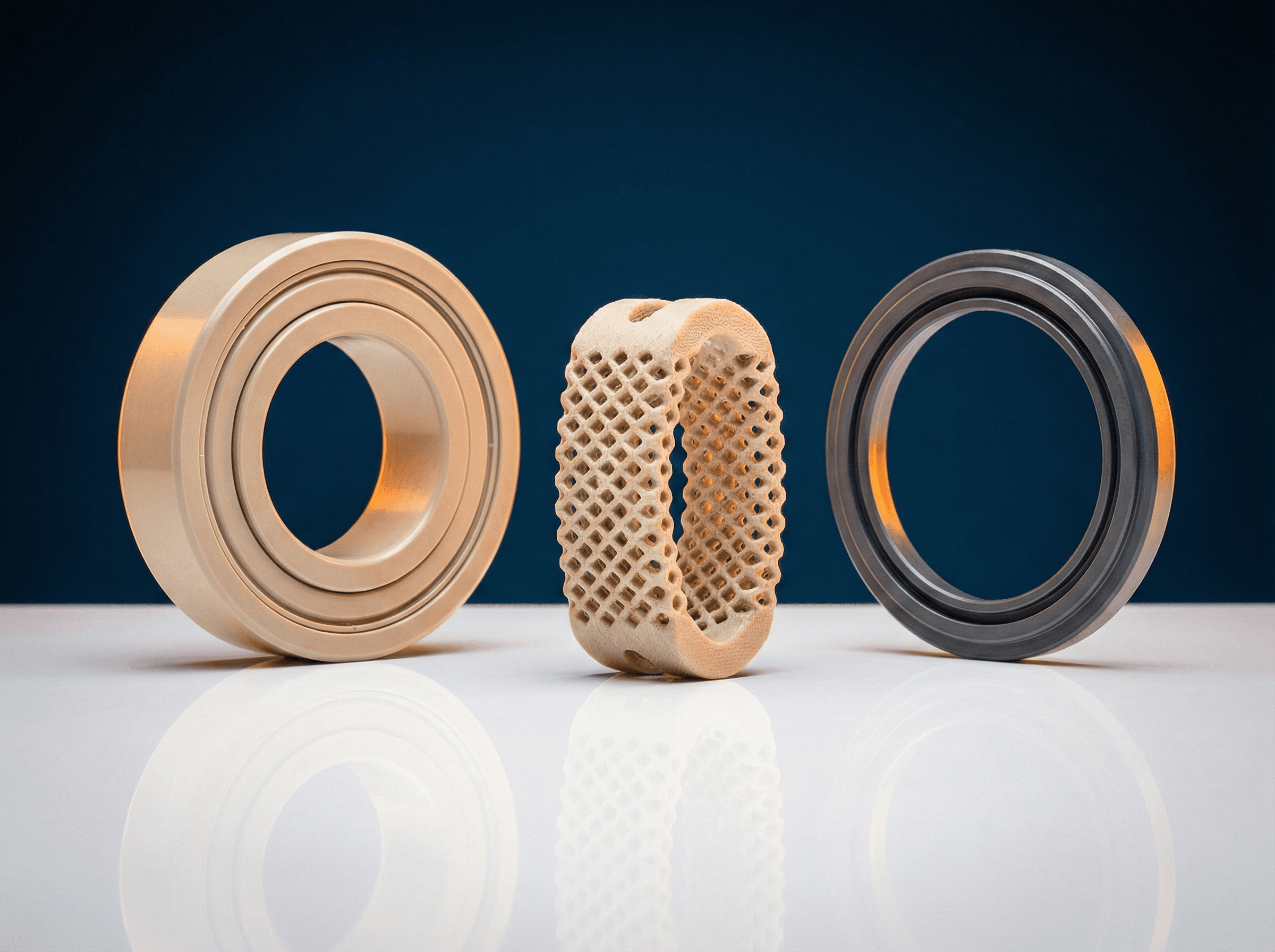
Key Benefits
- Extreme temperature resistance — continuous use to 260°C, melting point 343°C
- Outstanding chemical inertness — attacked only by concentrated sulfuric acid and select superacids
- Biocompatibility — USP Class VI and ISO 10993 for permanent implantable devices
- Inherent flame retardancy — achieves UL 94 V-0 without additives, with low smoke and toxic gas emission
- Radiation and sterilization resistance — withstands gamma, electron beam, ethylene oxide, and thousands of autoclave cycles
- Metal replacement capability — up to 70% weight reduction versus steel while eliminating corrosion and galvanic coupling
End Markets
Industries We Serve
- Packaging & Flexible Films
- Food & Beverage Packaging
- Construction & Pipe Systems
- Agriculture Applications
- Automotive Components
- Industrial Manufacturing
Frequently Asked Questions
PEEK (Polyether Ether Ketone) is a semi-crystalline thermoplastic from the polyaryletherketone (PAEK) family. It is classified as ultra-high-performance because it operates continuously at temperatures up to 260°C, resists virtually all known chemicals except concentrated sulfuric acid, is inherently flame retardant (UL 94 V-0), is biocompatible for permanent medical implants, and withstands radiation and repeated sterilization. PEEK can replace metals like stainless steel, titanium, and aluminum in the most demanding aerospace, medical, and industrial applications.
Syntex America supplies a comprehensive portfolio of PEEK grades including unfilled PEEK for medical implants and chemical processing, carbon-fiber reinforced PEEK (10-30% CF) for aerospace structural components and bearing applications, glass-fiber reinforced PEEK (10-30% GF) for electrical and structural applications, bearing and wear grades containing PTFE and graphite for self-lubricating applications, and medical/implantable grade PEEK manufactured under cGMP conditions with ASTM F2026 compliance for permanent surgical implants.
PEEK is used extensively in permanent implantable medical devices because of its biocompatibility (USP Class VI, ISO 10993), radiolucency (transparent to X-rays and CT imaging), and tunable elastic modulus that can approximate cortical bone (reducing stress shielding versus titanium). Common medical applications include spinal fusion cages (interbody devices), cranial reconstruction plates, dental implant abutments, trauma fixation plates and screws, and arthroscopic surgical instruments. Medical-grade PEEK is manufactured under cGMP with full lot traceability per ASTM F2026.
PEEK requires specialized high-temperature processing equipment. Injection molding uses melt temperatures of 370-400°C and mold temperatures of 175-200°C. Standard injection molding machines require barrel, screw, and hot runner components rated for these temperatures. Pre-drying (3 hours at 150°C) is recommended for optimal surface quality. Proper mold temperature is critical: temperatures below 175°C produce amorphous parts with reduced chemical resistance and wear properties. PEEK can also be machined from extruded stock shapes or processed by additive manufacturing using specialized high-temperature 3D printers.
PEEK offers up to 70% weight reduction compared to stainless steel and approximately 45% reduction versus titanium while maintaining comparable or superior performance in many applications. Unlike metals, PEEK is inherently corrosion-resistant, eliminates galvanic coupling in mixed-material assemblies, provides excellent fatigue resistance, and is transparent to radar (enabling use in radome structures). In aerospace, PEEK replaces aluminum brackets, titanium fasteners, and steel bushings. In oil and gas, PEEK replaces Inconel and Hastelloy components in downhole tools. The total cost of ownership is often lower than metals when considering weight savings, corrosion elimination, and extended service intervals.
Ready to spec a grade?
Specifications
| Density | 1.30–1.44g/cm³ |
|---|---|
| Tensile Strength | 100–212MPa |
| Heat Deflection Temperature (1.8 MPa) | 152–315°C |
| Impact Resistance (Izod, Notched) | 50–85J/m |
| Flexural Modulus | 4,100–21,000MPa |
| Continuous Use Temperature | 250–260°C |
| Melting Point | 343°C |
| Water Absorption (24h) | 0.10–0.14% |
Industry Standards & Compliance
PEEK complies with ASTM D6262 specifications for polyetheretherketone molding and extrusion materials. Medical-grade PEEK meets ASTM F2026 for surgical implant applications and is a USP Class VI biocompatible material per ISO 10993 testing. Aerospace grades conform to AMS 3914 and meet Airbus and Boeing material specifications. All grades inherently achieve UL 94 V-0 and meet FAR 25.853 requirements for heat release and smoke density in aircraft interiors.
ASTM D6262
Standard specification for polyetheretherketone (PEEK) molding and extrusion materials.
ASTM F2026
Standard for PEEK polymers used in surgical implant applications, met by medical-grade PEEK.
USP Class VI
U.S. Pharmacopeia biocompatibility classification met by medical and implantable grades.
ISO 10993
International biological evaluation standard for medical devices, met by medical-grade PEEK.
AMS 3914
Aerospace material specification met by aerospace grades, alongside Airbus and Boeing specifications.
UL 94 V-0
Flammability classification achieved inherently by all PEEK grades without additives.
FAR 25.853
Aircraft-interior heat-release and smoke-density requirements met by all PEEK grades.
Applications
- Aerospace structural brackets, clips, and fasteners replacing aluminum and titanium
- Aircraft interior components: seat structures, ducting, and wire insulation (FAR 25.853 compliant)
- Spinal fusion cages (interbody devices), cranial plates, and orthopedic trauma fixation
- Dental implant abutments, healing caps, and prosthetic frameworks
- Oil and gas downhole tools: seals, backup rings, electrical connectors, and compressor components
- Semiconductor wafer carriers, test sockets, and wet processing equipment
- Automotive transmission thrust washers, seal rings, and turbocharger components
- Chemical processing: pump impellers, valve seats, and reactor vessel internals
- Nuclear industry: radiation-resistant structural and insulation components
- Food and pharmaceutical processing: bearings, bushings, and seals for clean-in-place (CIP) environments
- Subsea oil and gas: umbilical tube liners, riser components, and flow line insulation
- Additive manufacturing: 3D-printed aerospace prototypes, medical guides, and custom implants