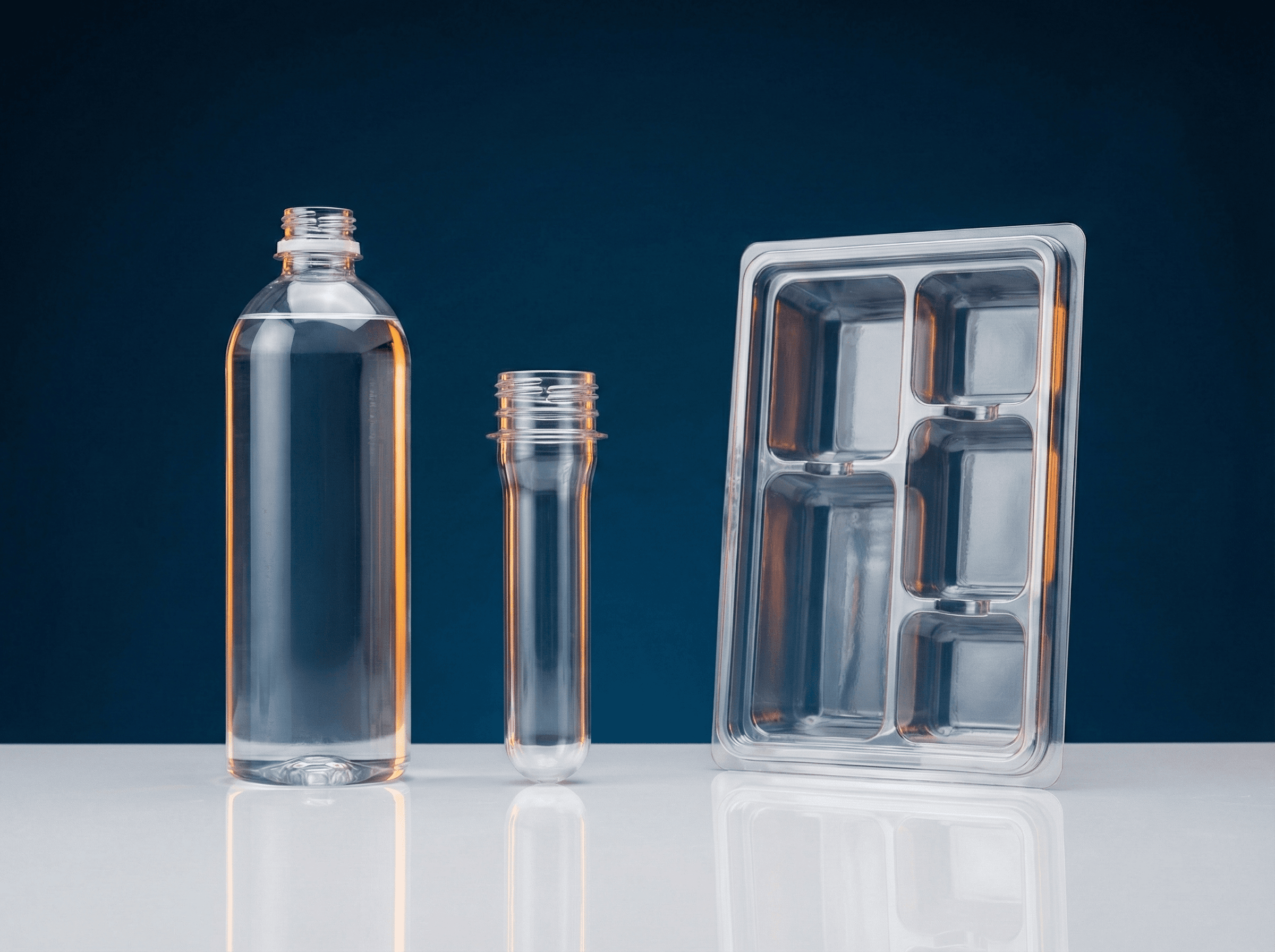
Key Benefits
- Excellent mechanical strength and structural integrity
- High transparency and gloss for premium presentation
- Lightweight design with high volume capacity
- Shatter-resistant material that reduces product waste
- Low environmental impact with reduced transport emissions
- FDA approved for food contact applications
End Markets
Industries We Serve
- Packaging & Flexible Films
- Food & Beverage Packaging
- Construction & Pipe Systems
- Agriculture Applications
- Automotive Components
- Industrial Manufacturing
Frequently Asked Questions
PET (Polyethylene Terephthalate) is a thermoplastic polyester polymer that dominates the global beverage packaging market, with production exceeding 30 million tonnes annually. It is primarily used for beverage bottles (carbonated drinks, water, juices), food packaging, cosmetics containers, and hot-fill applications. PET offers excellent mechanical strength, crystal-clear transparency, and is FDA approved for food contact.
Syntex America supplies several PET grades: PAPET COOL (IV 0.76-0.84 dl/g) for food and drinks packaging including mineral water, juices, and cosmetics; PAPET ACQUA (IV 0.74-0.76 dl/g) specifically for mineral water bottles; PAPET HOT (IV 0.80 dl/g) for hot-fill applications like juice and sports drinks; and PAPET ACE (IV 0.84 dl/g) for carbonated beverages with FAST REHEAT CHIP technology.
Yes, PET is one of the safest plastics for food contact. It meets FDA 21 CFR 177.1630 regulations and is approved by major beverage brands including Coca-Cola, Pepsi, and Evian. PET is chemically inert, contains no BPA or phthalates, and is widely used for water bottles, soft drink containers, and food packaging globally.
PET offers significant environmental benefits: 90% weight reduction compared to glass bottles reduces transportation emissions; shatter-resistant design minimizes product waste; highly recyclable material (recycling code 1); lower energy consumption in production compared to glass or aluminum; and reduced water usage in beverage filling operations. Recycled PET (rPET) is increasingly used in new bottle production.
Intrinsic Viscosity (IV), measured in dl/g, indicates the molecular weight of PET resin and directly affects its mechanical properties. Higher IV values (0.80-0.84 dl/g) are used for carbonated beverages requiring greater pressure resistance, while lower IV values (0.74-0.76 dl/g) are suitable for still water bottles. The correct IV selection ensures optimal bottle performance, clarity, and processing efficiency.
Ready to spec a grade?
Specifications
| PAPET COOL - Intrinsic Viscosity | 0.76/0.80/0.82/0.84dl/g |
|---|---|
| PAPET COOL - Applications | Food and drinks packing (mineral water, juices, cosmetics, etc.) |
| PAPET ACQUA - Intrinsic Viscosity | 0.74/0.76dl/g |
| PAPET ACQUA - Applications | Packaging of mineral water |
| PAPET HOT - Intrinsic Viscosity | 0.80dl/g |
| PAPET HOT - Applications | Resistant hot filling packaging (juice, sports drinks) |
| PAPET ACE - Intrinsic Viscosity | 0.84dl/g |
| PAPET ACE - Applications | Packaging for carbonated beverages with FAST REHEAT CHIP |
| Certifications | Approved by Coca-Cola, Pepsi, Evian and FDA |
| Special Features | Low molding temperature, high transparency and reduced machine cycle |
Industry Standards & Compliance
PET conforms to ASTM D4603 specifications for PET resins and ISO 1133 standards for melt mass-flow rate testing. For food contact applications, it meets FDA 21 CFR 177.1630 regulations and is approved by major beverage brands including Coca-Cola, Pepsi, and Evian. PET is chemically inert and contains no BPA or phthalates.
ASTM D4603
Standard specification for PET (polyethylene terephthalate) resins.
ISO 1133
International standard for melt mass-flow rate testing of thermoplastics.
FDA 21 CFR 177.1630
U.S. food-contact regulation covering PET resins for food and beverage packaging.
Applications
- Carbonated beverages (soft drinks, carbonated waters, beers)
- Mineral water bottles
- Juice packaging
- Sports drinks containers
- Cosmetics packaging
- Food packaging
- Hot-fill applications