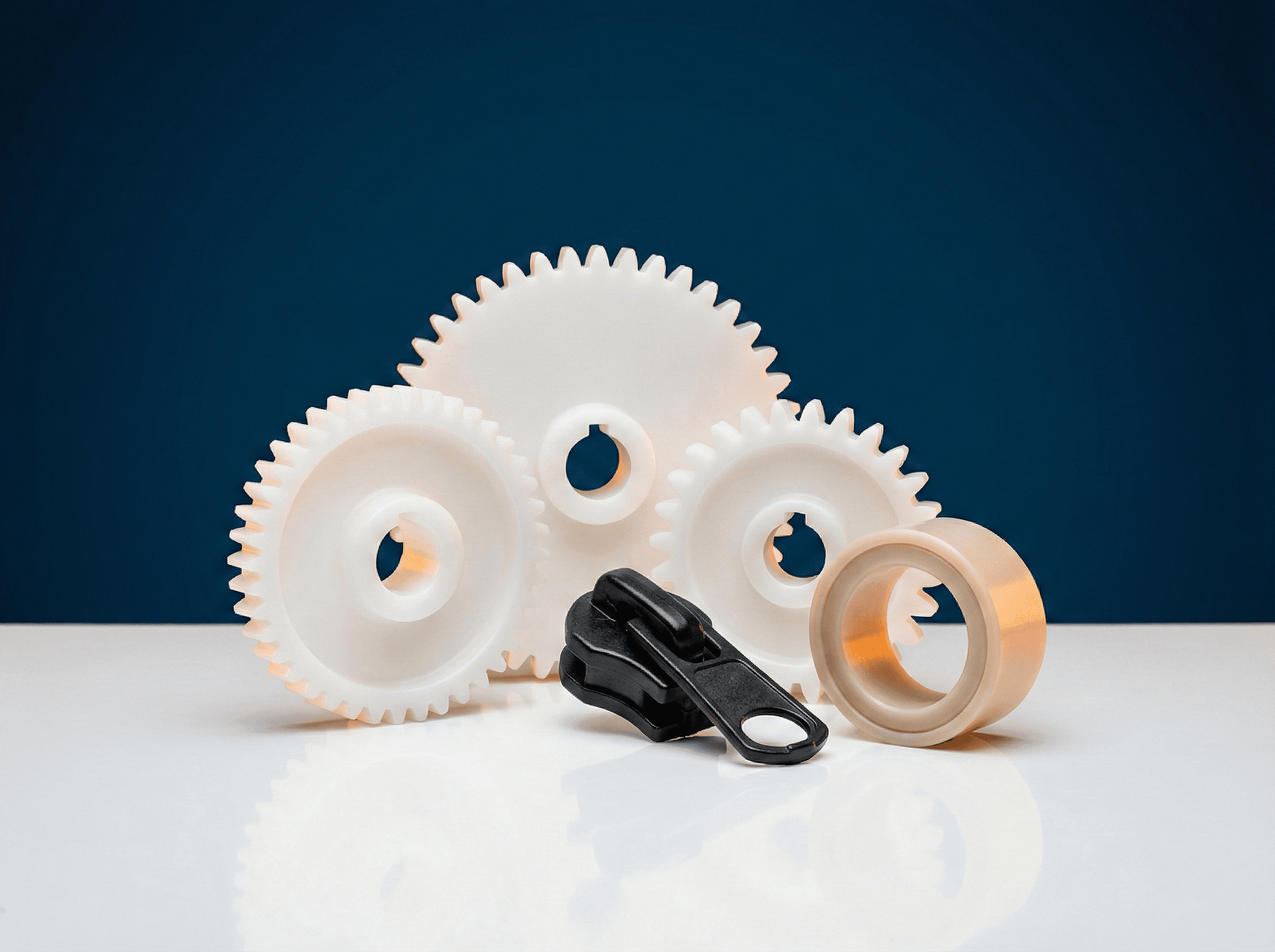
POM polyacetal product range: precision injection-molded gear assembly, automotive fuel system component, and low-friction bearing insert showcasing dimensional stability, mechanical precision, and fatigue resistance

POM - Polyacetal (Delrin)

High-stiffness, low-friction engineering thermoplastic for precision mechanical and industrial applications

Get a Quote for POM - Polyacetal (Delrin)

Response within 24 hours. No obligation.

We never share your informationNo obligation to purchase

Polyacetal (POM), also known as polyoxymethylene or by the trade name Delrin, is a high-performance semi-crystalline engineering thermoplastic widely recognized for its exceptional stiffness, low friction coefficient, outstanding dimensional stability, and superior fatigue resistance. First commercialized by DuPont in 1960, POM has become the material of choice for precision mechanical components that were traditionally manufactured from metals such as zinc, brass, and aluminum.

The global polyacetal market was valued at approximately $5.5 billion in 2024 and is projected to grow at a compound annual growth rate (CAGR) of 5.0% through 2030, driven by increasing metal replacement in automotive components, expanding demand for precision consumer electronics mechanisms, and growing applications in medical devices and plumbing systems. Global POM production exceeds 1.5 million tonnes annually, with automotive accounting for approximately 40% of total consumption according to industry data from Technavio.

Polyacetal resins comply with ASTM D4181 specifications for acetal (POM) molding and extrusion materials. Select grades are approved for food contact under FDA 21 CFR 177.2470, NSF/ANSI 61 for drinking water system components, and meet UL 94 HB classification. Grades for automotive fuel system applications comply with relevant SAE and EPA permeation standards.

Key properties of polyacetal include:

  • High stiffness and strength with a flexural modulus of 2,600–3,200 MPa and tensile strength of 60–70 MPa — among the highest of any unreinforced semi-crystalline thermoplastic.
  • Exceptionally low coefficient of friction (0.20–0.35 against steel) and excellent wear resistance, enabling gears, bearings, and sliding components to operate for millions of cycles without lubrication.
  • Outstanding dimensional stability with low and predictable shrinkage, minimal moisture absorption (0.20–0.25%), and excellent creep resistance under sustained load.
  • Superior fatigue endurance — POM withstands repeated cyclic loading better than virtually any other unreinforced engineering thermoplastic, critical for spring elements, snap-fit assemblies, and living hinges.
  • Good chemical resistance to aldehydes, esters, ethers, hydrocarbons, and most automotive fuels and lubricants. POM is particularly resistant to organic solvents that attack many other engineering plastics.
  • Excellent spring-back properties and elastic recovery, making POM ideal for snap-fit connections, spring clips, and flexible integral hinges.
  • Natural lubricity and low noise generation during operation, important for consumer electronics mechanisms, automotive interior components, and appliance drives.

Homopolymer vs. Copolymer

Polyacetal is commercially available in two distinct forms, each offering different performance characteristics:

  • POM Homopolymer (e.g., Delrin): Produced by polymerization of formaldehyde, POM homopolymer offers higher mechanical strength, stiffness, and hardness compared to copolymer. It has a higher melting point (178°C vs. 165°C) and slightly better short-term mechanical properties. Homopolymer is preferred where maximum mechanical performance and impact resistance are required.
  • POM Copolymer (e.g., Celcon, Hostaform): Produced by copolymerization of trioxane with small amounts of comonomer (typically ethylene oxide). Copolymer offers better thermal stability during processing, improved resistance to hot water and alkaline environments, lower centerline porosity in thick sections, and wider processing windows. Copolymer is preferred for parts in contact with hot water, thin-walled components, and applications requiring extended hot-runner processing.

Available Grades

Standard Homopolymer POM delivers the highest mechanical strength, stiffness, and fatigue resistance among unreinforced acetal grades. These grades are the benchmark for precision gears, cam mechanisms, and structural components requiring maximum mechanical performance.

Standard Copolymer POM provides excellent thermal processing stability, superior hot-water resistance, and broader processing latitude compared to homopolymer. Copolymer grades are preferred for plumbing fittings, hot-water applications, and thin-walled precision parts.

Low-Friction and PTFE-Filled POM grades incorporate PTFE (polytetrafluoroethylene), silicone, or other lubricant additives to further reduce the already low coefficient of friction. These grades are essential for applications where POM-on-POM or POM-on-metal sliding contact occurs, including printer mechanisms, conveyor guides, and automotive seat adjusters.

UV-Stabilized POM grades contain UV absorbers and stabilizers for outdoor applications where POM would otherwise degrade under prolonged ultraviolet exposure. These grades are used in garden equipment, automotive exterior mechanisms, and outdoor hardware.

Glass-Fiber-Reinforced POM grades containing 10% to 25% glass fiber provide increased stiffness, higher heat deflection temperature (up to 170°C), and reduced thermal expansion while maintaining good wear properties. These grades serve structural brackets, pump components, and precision housings requiring tight dimensional tolerances across temperature ranges.

Processing

Polyacetal is processed primarily by injection molding with recommended melt temperatures of 190–230°C for copolymer and 200–220°C for homopolymer, with mold temperatures of 60–120°C. Higher mold temperatures (80–120°C) improve crystallinity, surface finish, and dimensional stability. POM has relatively low moisture absorption, but drying at 80–90°C for 2–3 hours is recommended for optimal surface quality.

POM is also processed by extrusion (rod, sheet, profile), CNC machining of extruded stock shapes, and blow molding for hollow containers. Post-processing options include ultrasonic welding, hot-plate welding, spin welding, snap-fit assembly, press-fit insertion, and mechanical fastening. POM does not accept adhesive bonding or painting readily due to its low surface energy, though plasma and flame surface treatments can improve adhesion when required.

Frequently Asked Questions

POM homopolymer (e.g., Delrin) offers higher mechanical strength, stiffness, impact resistance, and a higher melting point (178°C vs. 165°C). POM copolymer (e.g., Celcon, Hostaform) provides better thermal stability during processing, superior resistance to hot water and alkaline environments, less centerline porosity in thick sections, and wider processing windows. Homopolymer is preferred for maximum mechanical performance, while copolymer is favored for plumbing, hot-water applications, thin-walled parts, and long hot-runner processing.

Syntex America supplies a complete range of polyacetal grades including standard homopolymer POM for maximum mechanical strength, standard copolymer POM for broad processing and hot-water applications, low-friction PTFE-filled POM for enhanced sliding performance, UV-stabilized POM for outdoor applications, and glass-fiber-reinforced POM for increased stiffness and heat deflection temperature.

POM offers several advantages over nylon (PA) for gear and bearing applications: significantly lower moisture absorption (0.22% vs. 1.6–2.5% for PA6), meaning POM parts maintain dimensional accuracy in humid environments without swelling. POM also has a lower and more consistent coefficient of friction, better dimensional stability, higher stiffness, and superior fatigue resistance. Nylon is preferred when higher impact strength or chemical resistance to fuels is the primary requirement.

Yes, select POM grades are approved for food contact under FDA 21 CFR 177.2470 and for potable water system components under NSF/ANSI 61. POM is widely used in coffee machine components, food dispensing mechanisms, water filter housings, and plumbing fittings. Copolymer grades are generally preferred for hot-water contact applications due to their superior hydrolysis resistance compared to homopolymer.

POM has limited UV resistance and will degrade with prolonged outdoor exposure; this is addressed with UV-stabilized grades. POM is not resistant to strong acids and oxidizing agents, which limits its use in aggressive chemical environments. It has relatively high shrinkage (1.8–2.5%) that must be accounted for in mold design. POM is difficult to bond with adhesives or paint due to its low surface energy, though plasma treatment can improve adhesion. For applications requiring flame retardancy, POM is challenging to formulate to UL 94 V-0, so alternative materials like PBT or PA may be more suitable.

Specifications

Density1.41–1.42g/cm³
Tensile Strength60–70MPa
Heat Deflection Temperature90–170°C
Impact Resistance (Izod, Notched)50–80J/m
Flexural Modulus2,600–3,200MPa
Coefficient of Friction (vs. Steel)0.20–0.35
Shrinkage1.8–2.5%
Water Absorption (24h)0.20–0.25%

Features

Exceptional Stiffness and Strength

Among the highest stiffness and tensile strength of any unreinforced semi-crystalline thermoplastic, enabling direct replacement of zinc, brass, and aluminum components

Low Friction and Wear Resistance

Naturally low coefficient of friction (0.20–0.35) and outstanding abrasion resistance allow gears and bearings to operate millions of cycles without external lubrication

Superior Dimensional Stability

Low moisture absorption (0.20–0.25%), minimal creep, and predictable shrinkage produce precision parts with tight tolerances across service conditions

Outstanding Fatigue Resistance

Best-in-class fatigue endurance among unreinforced engineering thermoplastics, critical for spring elements, snap-fits, and dynamic load-bearing components

Chemical and Fuel Resistance

Resistant to automotive fuels, lubricants, solvents, and most industrial chemicals, enabling reliable performance in demanding under-hood and fuel system applications

Natural Lubricity and Low Noise

Smooth, quiet operation in gear trains, sliding mechanisms, and consumer electronics drives without added lubricants or noise-dampening components

Applications

  • Precision gears, gear trains, and cam mechanisms for automotive, industrial, and consumer applications
  • Bearings, bushings, rollers, and sliding wear components requiring low friction
  • Automotive fuel system components including fuel sender units, fuel caps, and fuel pump parts
  • Automotive interior mechanisms: seat adjusters, window regulators, and door lock assemblies
  • Zippers, zipper sliders, and fastener hardware for apparel and luggage
  • Plumbing fittings, valves, and pump components for potable water systems (NSF 61)
  • Consumer electronics mechanisms: printer drives, keyboard key mechanisms, and fan assemblies
  • Spring clips, snap-fit connectors, and cable tie mounts requiring fatigue resistance
  • Conveyor chain links, guide rails, and material handling components
  • Medical device components including insulin pen mechanisms and inhaler assemblies
  • Aerosol valve components, spray nozzles, and dispensing mechanisms
  • Musical instrument keys, mechanical linkages, and precision control mechanisms