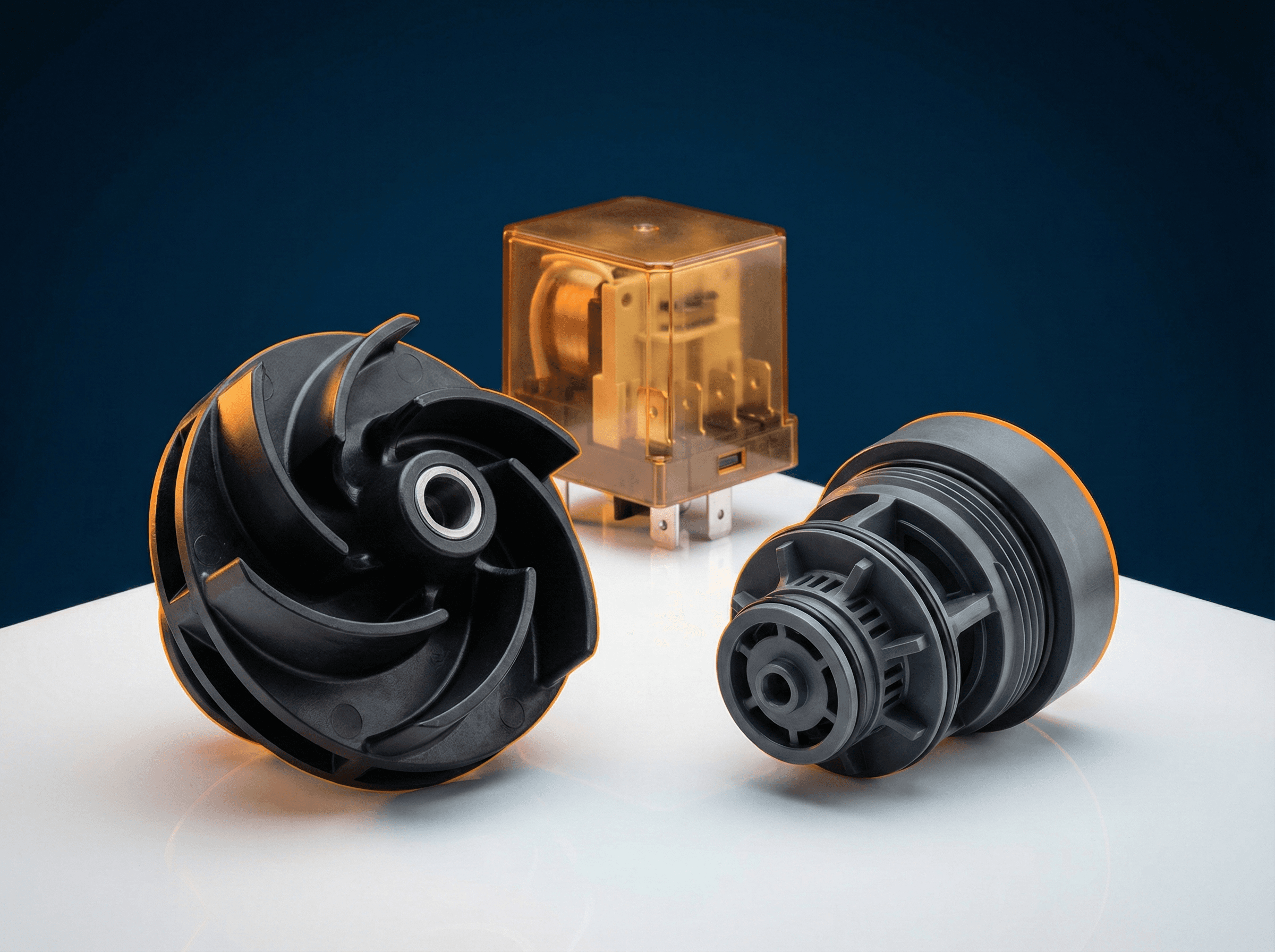
PPS product range: glass-filled automotive coolant pump impeller, black chemical-resistant valve body, and precision aerospace electrical connector demonstrating heat resistance, chemical inertness, and dimensional stability

PPS - Polyphenylene Sulfide

High-performance thermoplastic with inherent flame retardancy and exceptional chemical resistance for extreme environments

Get a Quote for PPS - Polyphenylene Sulfide

Response within 24 hours. No obligation.

We never share your informationNo obligation to purchase

Polyphenylene Sulfide (PPS) is a high-performance semi-crystalline engineering thermoplastic characterized by an aromatic backbone of alternating phenylene rings and sulfur atoms. This rigid molecular structure gives PPS an exceptional combination of properties: inherent flame retardancy without additives (UL 94 V-0), outstanding chemical resistance to virtually all known solvents below 200°C, high continuous-use temperatures up to 240°C, and excellent dimensional stability. PPS bridges the performance gap between conventional engineering thermoplastics and specialty polymers like PEEK.

The global PPS market was valued at approximately $1.8 billion in 2024 and is projected to grow at a compound annual growth rate (CAGR) of 7.2% through 2030, driven by increasing demand for metal-to-plastic conversion in automotive, electrical/electronic, and industrial applications. Global production capacity exceeds 180,000 tonnes annually, with major producers including Toray, DIC Corporation, Celanese, and Solvay.

PPS complies with ASTM D6358 specifications for polyphenylene sulfide (PPS) molding and extrusion materials. All grades inherently meet UL 94 V-0 flammability classification without the addition of flame retardant compounds. Select grades are approved for food contact and potable water applications under NSF/ANSI 61, and aerospace grades meet FAR 25.853 requirements for heat release and smoke density.

Key properties of PPS include:

  • Inherent flame retardancy achieving UL 94 V-0 rating without flame retardant additives, producing minimal smoke and toxic gas emission during combustion.
  • Exceptional chemical resistance to virtually all organic solvents, fuels, hydraulic fluids, acids, and bases below 200°C. PPS has no known solvent at temperatures below its melting point.
  • High heat resistance with a continuous-use temperature of 220°C and heat deflection temperatures exceeding 260°C in glass-filled grades.
  • Excellent dimensional stability with very low coefficient of thermal expansion, low creep, and minimal moisture absorption (0.02–0.05%).
  • High stiffness and strength in reinforced grades, with flexural moduli exceeding 14,000 MPa and tensile strengths above 190 MPa in 65% glass-filled formulations.
  • Outstanding resistance to hydrolysis, making PPS suitable for long-term exposure to steam, hot water, and coolant systems.
  • Excellent radiation resistance, maintaining mechanical properties under gamma and electron beam sterilization.

Chemical Structure and Polymer Types

PPS is synthesized by the reaction of para-dichlorobenzene with sodium sulfide in a polar solvent (typically N-methylpyrrolidone) at elevated temperatures and pressures. The resulting polymer consists of repeating para-phenylene sulfide units, producing a rigid, symmetrical chain structure that promotes high crystallinity (typically 50–65% in molded parts).

Two principal types of PPS are commercially available: linear PPS, produced through modern polymerization techniques yielding high molecular weight chains with superior toughness and elongation; and cross-linked (cured) PPS, an older technology where low molecular weight polymer is thermally cross-linked to improve melt stability. Linear PPS dominates modern applications due to its superior mechanical properties and more predictable processing behavior.

Available Grades

Linear PPS offers the highest toughness and elongation among PPS grades. Unfilled linear PPS is used in fiber, film, and coating applications, while serving as the base polymer for most compounded grades. Its high molecular weight provides excellent weld-line strength in complex multi-gated parts.

Glass-Fiber Reinforced PPS (40–65% GF) is the most widely used form of PPS, accounting for over 70% of total consumption. These grades provide exceptional stiffness, strength, and heat deflection temperatures. The 40% glass-filled grade is the industry standard for automotive and electrical applications, while higher loadings (55–65%) are used in structural components requiring maximum rigidity and creep resistance.

Mineral-Filled PPS incorporates mineral fillers (calcium carbonate, talc, or silica) to reduce warpage, improve surface finish, and lower cost relative to glass-filled grades. Mineral/glass hybrid formulations provide an optimized balance of dimensional stability, surface aesthetics, and mechanical performance.

Carbon-Fiber Reinforced PPS delivers the highest stiffness-to-weight ratio among PPS compounds, with flexural moduli exceeding 25,000 MPa. These grades are used in aerospace structural components, semiconductor handling equipment, and high-performance industrial applications where weight reduction is critical.

Cross-Linked PPS is produced by thermal curing of lower molecular weight PPS. While offering good chemical resistance and dimensional stability, cross-linked grades have lower toughness and elongation compared to linear PPS. They remain in use for specific coating, encapsulation, and legacy applications.

Processing

PPS is processed primarily by injection molding, with recommended melt temperatures of 300–340°C and mold temperatures of 130–150°C. High mold temperatures are essential to develop proper crystallinity, which directly affects chemical resistance, dimensional stability, and mechanical performance. Pre-drying is recommended (3–4 hours at 150°C) although PPS is less sensitive to moisture than polyesters and polyamides.

PPS can also be processed by extrusion (film, fiber, pipe), compression molding, and slurry coating. Its excellent flow properties and low flash characteristics make it well-suited for thin-wall and insert molding applications. Post-processing operations include annealing (to maximize crystallinity), ultrasonic welding, laser marking, and machining. PPS does not bond well with conventional adhesives due to its chemical inertness, requiring plasma or corona surface treatment for adhesive bonding applications.

Frequently Asked Questions

PPS (Polyphenylene Sulfide) is a semi-crystalline engineering thermoplastic with an aromatic backbone of alternating phenylene rings and sulfur atoms. It is classified as a high-performance thermoplastic because it offers inherent flame retardancy (UL 94 V-0 without additives), exceptional chemical resistance to virtually all solvents below 200°C, continuous-use temperatures up to 240°C, and excellent dimensional stability. PPS bridges the gap between conventional engineering plastics like PA and PBT and ultra-high-performance polymers like PEEK.

Syntex America supplies a complete portfolio of PPS grades including linear PPS for fiber, film, and coating applications, glass-fiber reinforced PPS (40-65% GF) for automotive and electrical components, mineral-filled PPS for low-warpage precision parts, carbon-fiber reinforced PPS for aerospace and semiconductor applications requiring maximum stiffness-to-weight ratio, and cross-linked PPS for specific coating and encapsulation uses.

PPS is ideal for automotive under-hood components because it withstands the combination of high temperatures (up to 240°C continuous), aggressive automotive fluids (coolant, fuel, oil, brake fluid), and sustained mechanical loads found in engine compartments. Its inherent flame retardancy, outstanding hydrolysis resistance, and dimensional stability under thermal cycling make it the material of choice for coolant pump impellers, thermostat housings, EGR valves, and turbocharger ducts. Glass-filled PPS also enables lightweight metal replacement, reducing vehicle weight.

PPS offers significantly higher heat resistance (HDT 260-275°C versus 65-260°C for PA66 and 50-225°C for PBT), superior chemical resistance (no known solvent at room temperature), inherent flame retardancy without additives, and much lower moisture absorption (0.02-0.05% versus 1.5-2.5% for PA). However, PPS typically has lower impact resistance than toughened PA or PBT grades and requires higher processing temperatures (melt 300-340°C, mold 130-150°C). PPS is chosen when the application demands cannot be met by lower-cost PA or PBT materials.

PPS requires melt temperatures of 300-340°C and elevated mold temperatures of 130-150°C to develop proper crystallinity, which is critical for chemical resistance and dimensional stability. Pre-drying (3-4 hours at 150°C) is recommended. PPS has excellent flow properties and very low flash, making it suitable for thin-wall and insert molding. Parts can be annealed after molding to maximize crystallinity. Due to its chemical inertness, adhesive bonding requires plasma or corona surface treatment.

Specifications

Density1.35–1.65g/cm³
Tensile Strength75–190MPa
Heat Deflection Temperature (1.8 MPa)260–275°C
Impact Resistance (Izod, Notched)15–75J/m
Flexural Modulus3,800–16,000MPa
Continuous Use Temperature200–240°C
Water Absorption (24h)0.02–0.05%
Flammability Rating (UL 94)V-0inherent

Features

Inherent Flame Retardancy

Achieves UL 94 V-0 rating without flame retardant additives, producing minimal smoke and toxic gas — ideal for confined-space electrical and transportation applications

Exceptional Chemical Resistance

Resistant to virtually all organic solvents, fuels, hydraulic fluids, and aqueous chemicals below 200°C with no known solvent at room temperature

High Heat Resistance

Continuous-use temperatures up to 240°C and HDT exceeding 260°C in glass-filled grades for demanding thermal environments

Dimensional Stability

Very low thermal expansion, minimal moisture absorption (0.02–0.05%), and excellent creep resistance ensure tight tolerances under sustained loads

Hydrolysis Resistance

Outstanding long-term resistance to steam, hot water, and automotive coolant systems — superior to polyesters and polyamides in wet thermal environments

Metal Replacement Capability

High stiffness-to-weight ratio in reinforced grades enables replacement of die-cast aluminum and zinc in automotive, aerospace, and industrial components

Applications

  • Automotive coolant system components: water pump impellers, thermostat housings, and coolant manifolds
  • Electrical and electronic connectors, bobbins, and high-temperature insulation components
  • Industrial chemical processing: pump housings, valve bodies, flow meters, and pipe fittings
  • Automotive under-hood components: EGR valves, turbocharger ducts, and exhaust gas sensors
  • Aerospace structural brackets, interior panels, and electrical connectors (FAR 25.853 compliant)
  • Oil and gas downhole tool components, seals, and chemical injection equipment
  • Semiconductor wafer processing equipment: wet bench components and chemical delivery systems
  • Appliance components: oven handles, microwave turntable supports, and heating element brackets
  • Fuel system components: fuel rail brackets, fuel filter housings, and vapor canisters
  • Surface mount technology (SMT) connectors and sockets for high-temperature reflow soldering
  • Coatings for non-stick cookware, chemical storage tanks, and industrial rollers