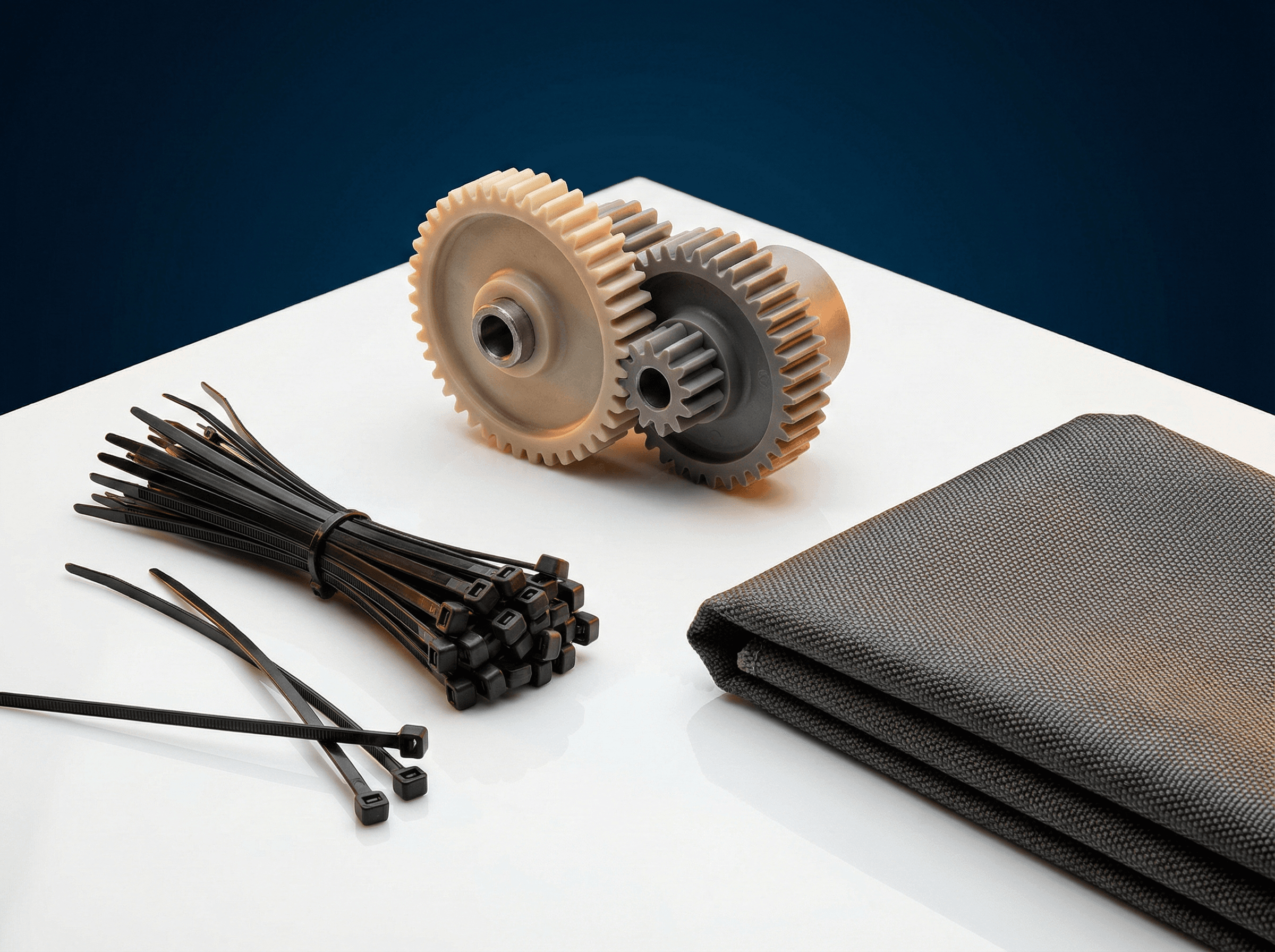
PA - Polyamide (Nylon)
High-performance semi-crystalline engineering thermoplastic for demanding mechanical and thermal applications
Get a Quote for PA - Polyamide (Nylon)
Response within 24 hours. No obligation.
Polyamide (PA), commonly known as nylon, is a family of semi-crystalline engineering thermoplastics renowned for their exceptional mechanical strength, outstanding wear and abrasion resistance, and broad chemical compatibility. First commercialized by DuPont in 1938, polyamides have become one of the most widely used engineering plastics across automotive, electrical, industrial, and consumer applications.
The global polyamide market was valued at approximately $33 billion in 2024 and is projected to grow at a compound annual growth rate (CAGR) of 5.8% through 2030, driven by lightweighting initiatives in automotive manufacturing, expanding electrical and electronics production, and increasing demand for high-performance industrial components. Global PA production exceeds 8 million tonnes annually, with PA6 and PA66 accounting for over 90% of total consumption according to industry data from ICIS.
Polyamide resins comply with ASTM D4066 specifications for nylon injection and extrusion materials. Select grades are approved for food contact under FDA 21 CFR 177.1500 regulations, and UL-recognized grades meet UL 94 V-0 and V-2 classifications for electrical and electronic applications. Glass-filled grades are tested per ASTM D638 and ISO 527 for tensile properties.
Key properties of polyamide include:
- High mechanical strength and rigidity, with tensile strengths ranging from 70 to 85 MPa for unfilled grades and exceeding 190 MPa for glass-fiber-reinforced compounds.
- Excellent wear and abrasion resistance combined with a naturally low coefficient of friction, making PA ideal for gears, bearings, and sliding contact surfaces without external lubrication.
- Good chemical resistance to oils, greases, fuels, hydraulic fluids, and most organic solvents, enabling use in demanding automotive and industrial environments.
- High heat deflection temperatures — PA66 withstands continuous service up to 120°C unfilled and up to 260°C in glass-reinforced formulations.
- Excellent fatigue endurance and vibration damping, critical for dynamic load-bearing components such as gears, snap-fit assemblies, and spring elements.
- Good electrical insulating properties with high dielectric strength, making PA the material of choice for electrical connectors, terminal blocks, and circuit breaker housings.
- Self-extinguishing behavior in many grades without added flame retardants, meeting UL 94 V-2 requirements.
PA Types and Chemistry
Polyamides are characterized by the amide linkage (–CO–NH–) in their polymer backbone. The two most commercially significant types differ in their monomer chemistry and resulting performance profiles:
- PA6 (Polycaprolactam): Produced by ring-opening polymerization of caprolactam. PA6 offers excellent surface finish, good impact strength, and easier processing compared to PA66. It is the preferred grade for extrusion applications and parts requiring superior aesthetics.
- PA66 (Polyhexamethylene Adipamide): Produced by condensation polymerization of hexamethylenediamine and adipic acid. PA66 provides higher melting point (260°C vs. 220°C), better rigidity, and superior heat resistance compared to PA6, making it the standard choice for under-hood automotive components.
- PA12 (Polylaurolactam): A specialty polyamide with lower moisture absorption (0.25% vs. 2.5% for PA6), greater flexibility, and excellent chemical resistance. PA12 is used in fuel lines, brake tubing, and cable sheathing where dimensional stability in humid environments is critical.
Available Grades
Unfilled PA6 and PA66 provide the baseline balance of mechanical strength, toughness, and processability for general-purpose injection molding and extrusion. These grades are used in cable ties, fasteners, housewares, and industrial components where reinforcement is not required.
Glass-Fiber-Reinforced PA grades containing 15% to 50% glass fiber deliver dramatically increased tensile strength (up to 200 MPa), stiffness, and heat deflection temperature while reducing moisture-related dimensional change. These grades are essential for structural automotive components, electrical connectors, and industrial housings.
Mineral-Filled PA grades incorporate mineral fillers (talc, wollastonite, or glass beads) to improve dimensional stability, reduce warpage, and provide isotropic shrinkage behavior. These grades are preferred for precision parts, flat panels, and components requiring tight tolerances.
Impact-Modified PA grades contain elastomeric modifiers (typically EPDM or maleated polyolefins) that significantly increase notched impact strength, particularly at sub-zero temperatures. These grades are used in automotive bumper components, sports equipment, and power tool housings.
PA12 and Long-Chain Polyamides offer reduced moisture absorption, greater flexibility, and enhanced chemical resistance compared to PA6 and PA66. PA12 is the material of choice for fuel lines, pneumatic tubing, and wire and cable jacketing in automotive and industrial applications.
Heat-Stabilized and UV-Stabilized PA grades incorporate thermal and UV stabilizer packages for extended service life in demanding environments, including under-hood automotive applications and outdoor electrical housings.
Processing
Polyamides are processed primarily by injection molding and extrusion. PA6 is molded at melt temperatures of 230–280°C with mold temperatures of 40–90°C, while PA66 requires melt temperatures of 270–300°C with mold temperatures of 60–100°C. Thorough drying is critical before processing — PA resins must be dried to moisture content below 0.2% to prevent hydrolytic degradation and surface defects. Desiccant dryers at 80–90°C for 4–6 hours are standard practice.
Polyamides are also processed by extrusion (profiles, tubing, film), blow molding, rotational molding, and powder-bed fusion (SLS) 3D printing. Post-processing options include machining, ultrasonic welding, hot-plate welding, adhesive bonding, and painting.
Frequently Asked Questions
PA6 and PA66 are the two most common polyamide types. PA6 (polycaprolactam) has a lower melting point (220°C), easier processing, better surface finish, and slightly higher impact strength. PA66 (polyhexamethylene adipamide) has a higher melting point (260°C), greater rigidity, higher tensile strength, and superior heat resistance. PA66 is preferred for under-hood automotive parts and high-temperature electrical components, while PA6 is favored for consumer goods, extrusion applications, and parts requiring excellent aesthetics.
Syntex America supplies a comprehensive range of polyamide grades including unfilled PA6 and PA66 for general-purpose molding, glass-fiber-reinforced PA (15–50% GF) for structural applications, mineral-filled PA for dimensional precision, impact-modified PA for low-temperature toughness, PA12 for fuel system and tubing applications, and heat-stabilized and UV-stabilized grades for demanding service environments.
Polyamide is hygroscopic, meaning it readily absorbs moisture from the atmosphere. Excess moisture (above 0.2%) causes hydrolytic degradation of the polymer chain during melt processing, resulting in reduced molecular weight, lower mechanical properties, surface defects (splay, silver streaks), and inconsistent part quality. Proper drying using a desiccant dryer at 80–90°C for 4–6 hours is essential before processing any polyamide resin.
Polyamide is used across virtually all major industries. Automotive (under-hood components, connectors, structural parts) is the largest market, followed by electrical and electronics (connectors, circuit breakers, terminal blocks), industrial machinery (gears, bearings, conveyor components), consumer goods (sports equipment, power tools, housewares), and transportation (fuel lines, brake tubing, cable sheathing). Glass-reinforced PA grades are increasingly replacing metals in structural automotive components for weight reduction.
Polyamide absorbs moisture from its environment, which affects part dimensions, mechanical properties, and electrical characteristics. Moisture absorption causes dimensional swelling (up to 2.5% for PA6 at saturation), reduces tensile strength and stiffness, but increases impact resistance and elongation at break. For applications requiring dimensional stability in humid environments, PA12 (0.25% absorption) or mineral-filled grades are preferred. Glass-fiber-reinforced grades also show reduced sensitivity to moisture effects.
Specifications
| Density | 1.01–1.15g/cm³ |
| Tensile Strength (Unfilled) | 70–85MPa |
| Tensile Strength (30% GF) | 150–195MPa |
| Heat Deflection Temperature | 65–260°C |
| Impact Resistance (Izod, Notched) | 30–120J/m |
| Flexural Modulus (Unfilled) | 2,700–3,200MPa |
| Moisture Absorption (24h) | 0.25–1.6% |
| Melting Point | 178–265°C |
Features
High Mechanical Strength
Exceptional tensile, flexural, and compressive strength that increases further with glass-fiber reinforcement, enabling structural load-bearing applications
Outstanding Wear Resistance
Naturally low coefficient of friction and excellent abrasion resistance allow gears, bearings, and sliding parts to operate without external lubrication
Broad Chemical Resistance
Resistant to oils, greases, fuels, hydraulic fluids, and most organic solvents, suitable for harsh automotive and industrial chemical environments
High Heat Performance
Glass-reinforced PA66 grades maintain structural integrity at continuous service temperatures up to 150°C with heat deflection temperatures exceeding 250°C
Fatigue and Vibration Damping
Superior fatigue endurance and vibration damping properties enable reliable performance in dynamic load-bearing components such as gears and snap-fit assemblies
Electrical Insulation
High dielectric strength and tracking resistance make polyamide the preferred material for electrical connectors, terminal blocks, and circuit breaker components
Applications
- Automotive under-hood components including intake manifolds, radiator end tanks, and engine covers
- Gears, bearings, bushings, and self-lubricating mechanical components
- Electrical connectors, terminal blocks, and circuit breaker housings
- Cable ties, fasteners, and industrial mounting hardware
- Sports and recreational equipment including ski bindings and bicycle components
- Power tool housings and structural internal components
- Fuel lines, brake tubing, and pneumatic hose systems (PA12)
- Textile machinery components and industrial conveyor parts
- Wire and cable jacketing for automotive and industrial applications
- Food packaging film and barrier layers in multilayer structures
- Furniture casters, office chair mechanisms, and structural fittings
- 3D-printed functional prototypes and end-use parts via SLS and FDM
