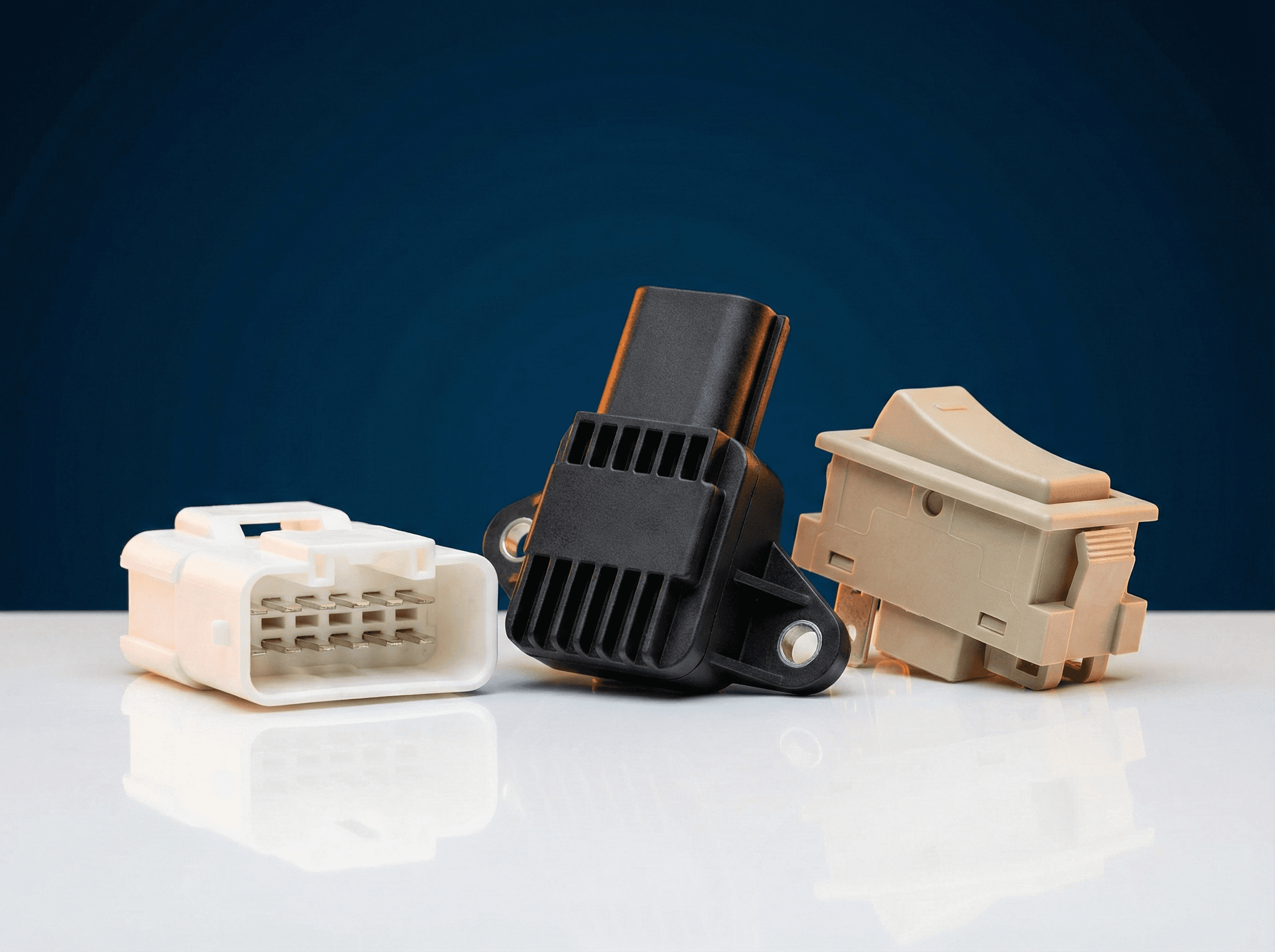
PBT product range: glass-filled automotive connector housing, black electrical relay enclosure, and mineral-filled fiber optic ferrule demonstrating dimensional precision, electrical insulation, and chemical resistance

PBT - Polybutylene Terephthalate

Fast-crystallizing semi-crystalline thermoplastic for precision electrical and automotive components

Get a Quote for PBT - Polybutylene Terephthalate

Response within 24 hours. No obligation.

We never share your informationNo obligation to purchase

Polybutylene Terephthalate (PBT) is a semi-crystalline engineering thermoplastic belonging to the polyester family. Produced by the polycondensation of 1,4-butanediol with terephthalic acid (or dimethyl terephthalate), PBT is valued for its fast crystallization rate, excellent electrical insulating properties, good chemical resistance, and low moisture absorption. These characteristics make it a preferred material for precision-molded electrical connectors, automotive components, and household appliance parts.

The global PBT market was valued at approximately $3.5 billion in 2024 and is projected to grow at a compound annual growth rate (CAGR) of 6.1% through 2030, driven by increasing demand in automotive electrification, miniaturized electronics, and fiber optic telecommunications. Global production capacity exceeds 2 million tonnes annually, with major producers including BASF, DuPont, Toray, and SABIC.

PBT complies with ASTM D5927 specifications for polybutylene terephthalate (PBT) molding and extrusion materials. Select grades meet UL 94 V-0 flame ratings and are recognized under UL Yellow Card programs. Food-contact grades are available in compliance with FDA 21 CFR 177.1660, and automotive grades meet major OEM specifications.

Key properties of PBT include:

  • Fast crystallization rate enabling short injection molding cycle times, even at low mold temperatures — reducing production costs and improving throughput.
  • Excellent electrical insulating properties with high dielectric strength, low dissipation factor, and stable electrical performance across a wide temperature and frequency range.
  • Good chemical resistance to fuels, oils, greases, most solvents, and dilute acids and bases, making PBT suitable for under-hood automotive and industrial chemical environments.
  • Low moisture absorption (0.08–0.10% at equilibrium) providing excellent dimensional stability in humid conditions — a significant advantage over nylon (PA) competitors.
  • High stiffness and strength, particularly in glass-fiber reinforced grades where tensile strength can exceed 130 MPa.
  • Good resistance to weathering and UV degradation in stabilized grades, enabling outdoor applications.
  • Excellent creep resistance under sustained mechanical and thermal loads.

Chemical Structure and Crystallization

PBT is a linear aromatic polyester with a backbone comprising terephthalate ester groups linked by four-carbon (butylene) segments. The four-methylene spacer in PBT — compared to the two-methylene spacer in PET — provides greater chain flexibility, resulting in significantly faster crystallization kinetics. This rapid crystallization is the primary advantage PBT holds over PET in injection molding: PBT achieves high crystallinity at lower mold temperatures (40–80°C versus 120–140°C for PET), enabling shorter cycle times without sacrificing part quality.

Typical crystallinity levels in molded PBT range from 35% to 45%, contributing to its chemical resistance, dimensional stability, and mechanical strength. The degree of crystallinity can be influenced by mold temperature, cooling rate, and nucleating agents.

Available Grades

Unfilled PBT offers a balanced combination of toughness, flexibility, and electrical insulation for general-purpose applications. Unfilled grades are commonly used in electrical connectors, switch components, and applications where weld-line strength and elongation are critical.

Glass-Fiber Reinforced PBT (10–50% GF) provides dramatically increased stiffness, tensile strength, and heat deflection temperature. Glass-filled grades at 30% loading are the industry standard for automotive connectors and under-hood components. Higher glass loadings (40–50%) are used in structural brackets and high-temperature housings where HDT values exceeding 220°C are required.

Flame-Retardant PBT incorporates halogenated or non-halogenated flame retardant systems to achieve UL 94 V-0 ratings at wall thicknesses as low as 0.4 mm. These grades are essential for electrical connectors, circuit breakers, and relay housings used in automotive and industrial electrical systems.

Mineral-Filled PBT uses mineral fillers (talc, wollastonite, or barium sulfate) to improve dimensional stability, reduce warpage, and produce smooth surface finishes. These grades are preferred for flat, thin-walled parts such as sensor housings, mirror housings, and cosmetic automotive components.

Impact-Modified PBT incorporates elastomeric modifiers to enhance toughness and ductility at the expense of some stiffness and heat resistance. Impact-modified grades are used in automotive bumper components, exterior door handles, and wiper system parts that must survive low-temperature impacts.

Processing

PBT is processed primarily by injection molding, with recommended melt temperatures of 230–270°C and mold temperatures of 40–80°C. Pre-drying is essential: PBT should be dried to below 0.02% moisture content (typically 3–4 hours at 120°C in a dehumidifying dryer) to prevent hydrolytic degradation during processing. PBT can also be processed by extrusion for film, fiber, and monofilament applications.

PBT accepts a range of post-processing operations including ultrasonic welding, laser welding, adhesive bonding, insert molding, and overmolding with elastomers. Its excellent flow properties and fast crystallization make it well-suited for high-cavity, high-speed production of miniaturized connectors and electronic components.

Frequently Asked Questions

PBT (Polybutylene Terephthalate) is a semi-crystalline engineering thermoplastic polyester. While chemically similar to PET, PBT has a four-carbon butylene spacer instead of PET's two-carbon ethylene spacer, giving PBT significantly faster crystallization kinetics. This means PBT can be injection molded at lower mold temperatures with shorter cycle times, making it more cost-effective for high-volume production of connectors, automotive components, and electrical housings.

Syntex America supplies a comprehensive range of PBT grades including unfilled PBT for general-purpose electrical applications, glass-fiber reinforced PBT (10-50% GF) for structural and high-temperature components, flame-retardant PBT meeting UL 94 V-0 for electrical safety applications, mineral-filled PBT for low-warpage precision parts, and impact-modified PBT for automotive exterior components requiring low-temperature toughness.

PBT is preferred over nylon (PA6, PA66) for electrical connectors because of its significantly lower moisture absorption — approximately 0.08% versus 2.5% for nylon. This low moisture uptake means PBT connectors maintain their dimensional accuracy, electrical insulation properties, and mechanical performance in humid environments without requiring moisture conditioning. PBT also offers better dimensional stability, more consistent dielectric properties, and faster molding cycle times.

PBT should be pre-dried to below 0.02% moisture content (3-4 hours at 120°C in a dehumidifying dryer) before processing. Recommended melt temperatures are 230-270°C with mold temperatures of 40-80°C. Higher mold temperatures produce parts with greater crystallinity, improved chemical resistance, and better surface finish but longer cycle times. PBT's fast crystallization allows the use of lower mold temperatures than PET while still achieving adequate crystallinity.

The primary growth drivers for PBT are automotive electrification (EV battery connectors, charging systems, power electronics housings), telecommunications (fiber optic connectors and 5G infrastructure components), consumer electronics (miniaturized connectors, USB-C housings), and industrial automation (sensor housings, relay components). The automotive sector alone accounts for over 40% of global PBT consumption, with demand accelerating as vehicles incorporate more electronic systems.

Specifications

Density1.31–1.52g/cm³
Tensile Strength50–130MPa
Heat Deflection Temperature (1.8 MPa)50–225°C
Impact Resistance (Izod, Notched)30–60J/m
Flexural Modulus2,300–11,000MPa
Dielectric Strength17–23kV/mm
Water Absorption (24h)0.08–0.10%
Shrinkage0.3–2.0%

Features

Fast Crystallization

Rapid crystallization kinetics enable short injection molding cycle times at low mold temperatures, reducing production costs and improving throughput

Excellent Electrical Insulation

High dielectric strength, low dissipation factor, and stable electrical properties across a wide temperature and frequency range for precision electronic components

Low Moisture Absorption

Moisture uptake as low as 0.08% ensures dimensional stability in humid environments — a significant advantage over nylon-based alternatives

Chemical Resistance

Withstands exposure to fuels, oils, greases, most organic solvents, and dilute acids and bases encountered in automotive and industrial applications

Dimensional Precision

Low and predictable shrinkage combined with excellent creep resistance produces tight-tolerance parts for connector and sensor applications

Flame Retardancy Options

Available in UL 94 V-0 rated formulations at thicknesses as low as 0.4 mm for demanding electrical safety requirements

Applications

  • Automotive electrical connectors, terminal housings, and multi-pin headers
  • Ignition coil bobbins, distributor caps, and engine management components
  • Electrical relay housings, circuit breakers, and contactors
  • Fiber optic connectors, ferrules, and telecommunications components
  • Household appliance switches, motor housings, and control panels
  • Sensor housings, proximity switches, and industrial automation components
  • Automotive exterior door handles, mirror housings, and wiper system parts
  • LED lighting housings and reflector components
  • Pump impellers and industrial fluid handling components
  • Miniature connectors for consumer electronics and mobile devices