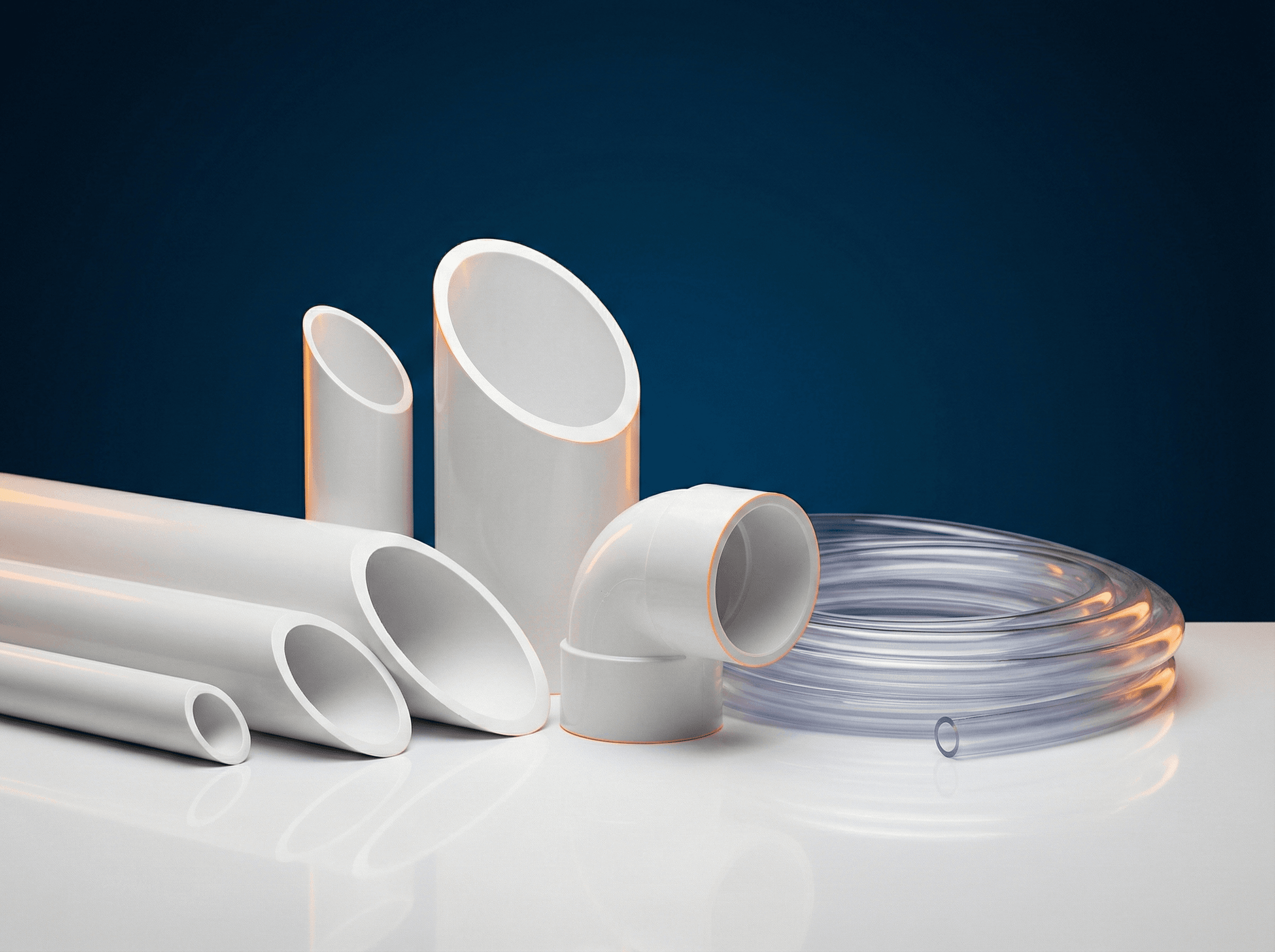
Key Benefits
- Does not spread flame: self-extinguishing
- Service life in buildings of more than 50 years
- Resistance to most chemical reagents
- Resistance to weathering (sun, rain, wind, and sea)
- Good thermal, electrical, and acoustic insulation
- Fully recyclable material
Resin Portfolio
Syntex America supplies the full PVC range — suspension (S-PVC) for rigid pipe, profile and fittings and for flexible film, wire and cable; mass (M-PVC) for high-clarity rigid extrusion; copolymer for vinyl flooring, coatings and films; and paste (E-PVC) emulsion resins for coating, dipping, rotomoulding and foam — from EPC and TCI Sanmar in Egypt and Formosa Plastics (FPC) in Taiwan, spanning the K48–81 viscosity spectrum for construction, packaging, wire and cable, flooring and footwear applications.
Suspension PVC (S-PVC)
The workhorse family — rigid through flexible across the K-value range.
Applications: Pressure & water pipe, Window & door profiles, Rigid sheet, Wire & cable, Flexible film & hose, Footwear.
| Grade | Manufacturer | K-value | Bulk Density | Application | Actions |
|---|---|---|---|---|---|
| S-58 | Formosa Plastics (FPC) | 56.6–58.3 | 0.57 ± 0.02 g/cm³ | Fittings and thin-wall rigid parts. | |
| S-60 | Formosa Plastics (FPC) | 59.2–60.6 | 0.55 ± 0.02 g/cm³ | Fittings and thin-wall rigid parts. | |
| S-65 | Formosa Plastics (FPC) | 64.6–66.0 | 0.50 ± 0.02 g/cm³ | Rigid pipe, profile, sheet and fittings. | |
| S-65S | Formosa Plastics (FPC) | 64.6–66.0 | 0.48 ± 0.02 g/cm³ | Rigid pipe, profile, sheet and fittings. | |
| S-65D | Formosa Plastics (FPC) | 65.7–67.1 | 0.55 ± 0.02 g/cm³ | Rigid pipe, profile, sheet and fittings. | |
| K67 | Egyptian Petrochemicals (EPC) | 67 (IV 0.90–0.94) | 0.49–0.56 g/cm³ | Window & door profiles, pressure & corrugated pipes, and marble-alternative compounds. | |
| K6701+ | TCI Sanmar | 67 ± 1 | 0.54–0.59 g/ml | Rigid pipes (potable water, SWR, drainage), window profiles, rigid sheets, conduit & trunking, wire & cable, and footwear compounds. | |
| S-70 | Formosa Plastics (FPC) | 69.6–71.5 | 0.47 ± 0.02 g/cm³ | Flexible film, wire & cable, hose and calendered sheet. | |
| S-70R | Formosa Plastics (FPC) | 69.6–71.5 | 0.47 ± 0.02 g/cm³ | Flexible film, wire & cable, hose and calendered sheet. | |
| S-73R | Formosa Plastics (FPC) | 72.5–74.3 | 0.46 ± 0.02 g/cm³ | Flexible film, wire & cable, hose and calendered sheet. | |
| S-75 | Formosa Plastics (FPC) | 73.4–75.2 | 0.45 ± 0.02 g/cm³ | Highly plasticised compounds, coatings and flexible film. | |
| S-80 | Formosa Plastics (FPC) | 79.4–81.1 | 0.45 ± 0.02 g/cm³ | Highly plasticised compounds, coatings and flexible film. |
K67-class rows: EPC K67 (IV 0.90–0.94 dp/gm, residual VCM ≤ 1 ppm) and TCI Sanmar K6701+ (low porosity, in 25 kg & 1250 kg bags). Formosa applications are typical uses by K-value (the FPC leaflet lists no per-grade applications). Test methods: K-value DIN 53726; bulk density JIS K6721.
Mass PVC (M-PVC)
High-purity, high-clarity rigid PVC (no suspension agents).
Applications: Transparent rigid sheet, Profiles, Pipe & fittings.
| Grade | Manufacturer | K-value | Bulk Density | Application | Actions |
|---|---|---|---|---|---|
| B-57 | Formosa Plastics (FPC) | 54.1–56.0 | 0.60 ± 0.02 g/cm³ | Fittings and thin-wall rigid parts. | |
| B-57C | Formosa Plastics (FPC) | 54.1–56.0 | 0.60 ± 0.02 g/cm³ | Fittings and thin-wall rigid parts. | |
| B-60 | Formosa Plastics (FPC) | 57.8–59.4 | 0.60 ± 0.02 g/cm³ | Fittings and thin-wall rigid parts. | |
| B-60S | Formosa Plastics (FPC) | 57.8–59.4 | 0.60 ± 0.02 g/cm³ | Fittings and thin-wall rigid parts. | |
| B-62S | Formosa Plastics (FPC) | 59.4–60.8 | 0.60 ± 0.02 g/cm³ | Fittings and thin-wall rigid parts. | |
| B-65 | Formosa Plastics (FPC) | 64.6–66.0 | 0.57 ± 0.02 g/cm³ | Rigid pipe, profile, sheet and fittings. | |
| B-65C | Formosa Plastics (FPC) | 64.6–66.0 | 0.57 ± 0.02 g/cm³ | Rigid pipe, profile, sheet and fittings. |
Formosa Plastics (FPC), Taiwan. Applications are typical uses by K-value. Test methods: K-value DIN 53726; bulk density JIS K6721.
Copolymer PVC
Vinyl chloride–vinyl acetate copolymers for flooring and coatings.
Applications: Vinyl flooring, Coatings, Heat-seal films, Records.
| Grade | Manufacturer | K-value | Bulk Density | Application | Actions |
|---|---|---|---|---|---|
| C-8 | Formosa Plastics (FPC) | 58.9–61.6 | 0.50 ± 0.03 g/cm³ | Vinyl flooring, coatings and heat-seal films. | |
| C-15 | Formosa Plastics (FPC) | 47.8–51.2 | 0.50 ± 0.03 g/cm³ | Vinyl flooring, coatings and heat-seal films. | |
| C-15C | Formosa Plastics (FPC) | 59.0–60.8 | 0.58 ± 0.03 g/cm³ | Vinyl flooring, coatings and heat-seal films. | |
| C-1250M | Formosa Plastics (FPC) | ~70 | 0.40 ± 0.03 g/cm³ | Vinyl flooring, coatings and heat-seal films. |
Vinyl acetate (VAC) content: C-8 8.0 ± 1.0%, C-15 & C-15C 12.5 ± 1.0%. Formosa Plastics (FPC), Taiwan. Applications are typical uses.
Paste PVC (E-PVC)
Emulsion resins for coating, dipping and foam.
Applications: Dip & spread coating, Sealants, Gloves, Flooring, Foam.
| Grade | Manufacturer | K-value | Bulk Density | Application | Actions |
|---|---|---|---|---|---|
| PR-L | Formosa Plastics (FPC) | 65 | 0.30 ± 0.05 g/cm³ | Dip & spread coating, sealants, gloves, flooring and foam. | |
| PR-M | Formosa Plastics (FPC) | 72 | 0.30 ± 0.05 g/cm³ | Dip & spread coating, sealants, gloves, flooring and foam. | |
| PR-F | Formosa Plastics (FPC) | 75.5 | 0.30 ± 0.05 g/cm³ | Dip & spread coating, sealants, gloves, flooring and foam. | |
| PR-G | Formosa Plastics (FPC) | 76.5 | 0.30 ± 0.05 g/cm³ | Dip & spread coating, sealants, gloves, flooring and foam. |
Paste (emulsion) PVC supplied as fine powder. Formosa Plastics (FPC), Taiwan. Applications are typical uses.
End Markets
Industries We Serve
- Packaging & Flexible Films
- Food & Beverage Packaging
- Construction & Pipe Systems
- Agriculture Applications
- Automotive Components
- Industrial Manufacturing
Frequently Asked Questions
Rigid PVC (PVC-U) contains no plasticizers — strong and durable for pipe, profile, fittings and siding. Flexible PVC adds plasticizers to become soft and pliable for wire and cable insulation, flooring, medical tubing and film. The same base resin yields both through formulation. Syntex America supplies the full K-value range — suspension, mass, paste and copolymer — from EPC, TCI Sanmar and Formosa.
Yes, depending on the grade and additive system — food-contact PVC is documented to FDA 21 CFR 177.1975 and EU Regulation 10/2011. Documentation can be provided upon request.
MOQ depends on the grade and availability. Contact us for details.
Yes. We can support exports and provide logistics documentation.
Ready to spec a grade?
Market Intelligence & Supply Insights
Stay informed with updated perspectives on:
- PVC market trends
- Freight market dynamics
- Regional availability
- Global supply conditions
- Additives & filler economics

Syntex America combines commercial responsiveness with market intelligence to help customers make better sourcing decisions.
Suspension vs Mass vs Paste vs Copolymer PVC — At a Glance
| Property | Suspension (S-PVC) | Mass (M-PVC) | Paste (E-PVC) | Copolymer |
|---|---|---|---|---|
| Polymerization route | Water + suspending agent | Bulk — monomer only, no water | Emulsion → spray-dried to fine powder | Suspension of vinyl chloride + vinyl acetate |
| K-value range (ISO 1628-2) | K57–81 | K54–66 | K65–77 | K48–70 |
| Particle form | Porous grains ~100–180 µm | Clean porous grains, low residue | Fine primary particles ~1–2 µm (forms plastisol) | Free-flowing powder, lower softening point |
| Purity & clarity | Good — general purpose | Highest — no suspension aids, high clarity | Lower — surfactant residue | Good — easy fusion, low Tg |
| Processing form | Dry-blend → extrusion, calendering | Dry-blend → high-clarity extrusion | Plastisol → coating, dipping, rotomoulding, foam | Dry-blend → calendering, coating, films |
| Typical applications | Pipe, profile, fittings, film, wire & cable | Clear bottles, transparent profiles & fittings | Flooring wear-layer, coated fabrics, gloves, foam | Vinyl flooring tiles, coatings, films, adhesives |
Specifications
| Material Classification | ASTM D1784 (Standard Specification for Rigid PVC and CPVC Compounds); ISO 1163-1 / ISO 1163-2 (Unplasticized PVC moulding and extrusion materials) |
|---|---|
| Test Methods | ISO 1628-2 / ASTM D1243 (K-value & dilute-solution viscosity), ASTM D792 (density), ASTM D1895 (apparent / bulk density), ASTM D638 (tensile), ASTM D790 (flexural modulus) |
| Resin Identification Code | 3 (PVC / V), ASTM D7611 |
| Food-Contact Compliance | FDA 21 CFR 177.1975 (vinyl chloride polymers) and EU Regulation (EU) No 10/2011 — subject to the additive and stabilizer system; written Statement of Compliance supplied per production lot at order |
| NCM Tariff Classification | 3904.10 (PVC not mixed with other substances — suspension & mass resin); 3904.21 (non-plasticised compounds); 3904.22 (plasticised compounds); 3904.30 (vinyl chloride–vinyl acetate copolymers) |
Industry Standards & Compliance
PVC complies with ASTM D1784 specifications for rigid PVC compounds and ISO 1163 standards for unplasticized PVC pressure pipes. For food contact applications, PVC meets FDA 21 CFR 177.1975 regulations and European Union Regulation 10/2011 requirements.
ASTM D1784
Standard specification for rigid PVC compounds.
ISO 1163
Standard for unplasticized PVC pressure pipes.
FDA 21 CFR 177.1975
U.S. food-contact regulation for PVC applications.
EU Regulation 10/2011
European Union requirements for plastics in food contact.
Related Products
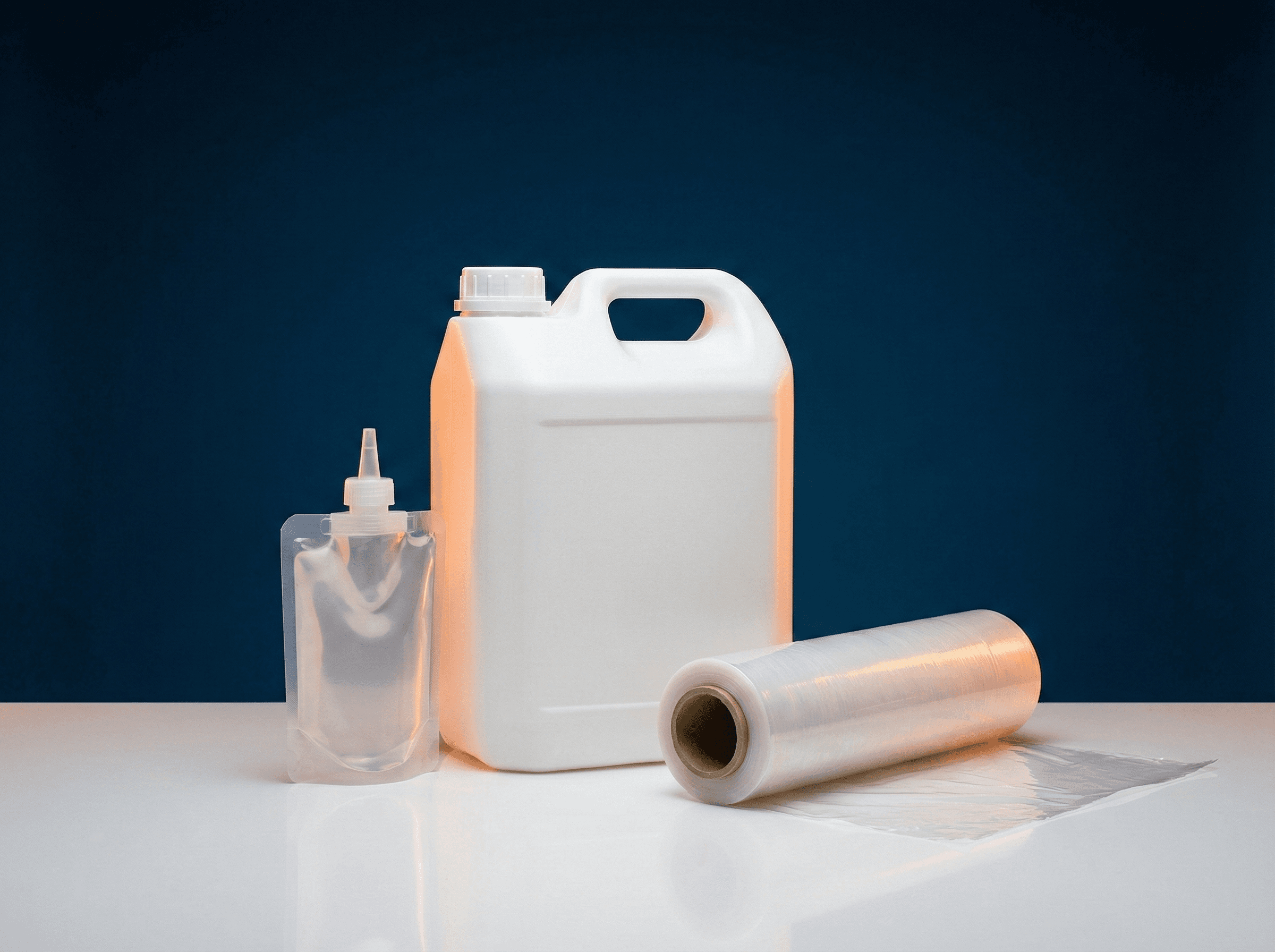
Polyethylene (PE) Resins
Polyethylene resin catalog — HDPE, mLLDPE, LLDPE and LDPE for blown & cast film, blow moulding, injection, PE100/PE80 pipe, filament, rotomoulding and extrusion coating. Grades from ExxonMobil, SABIC, Dow, NOVA, SCGC, Chevron Phillips, BASF, SIDPEC, Sinopec, Hengli, ZPC and Wanhua, with fast quotes and datasheets.
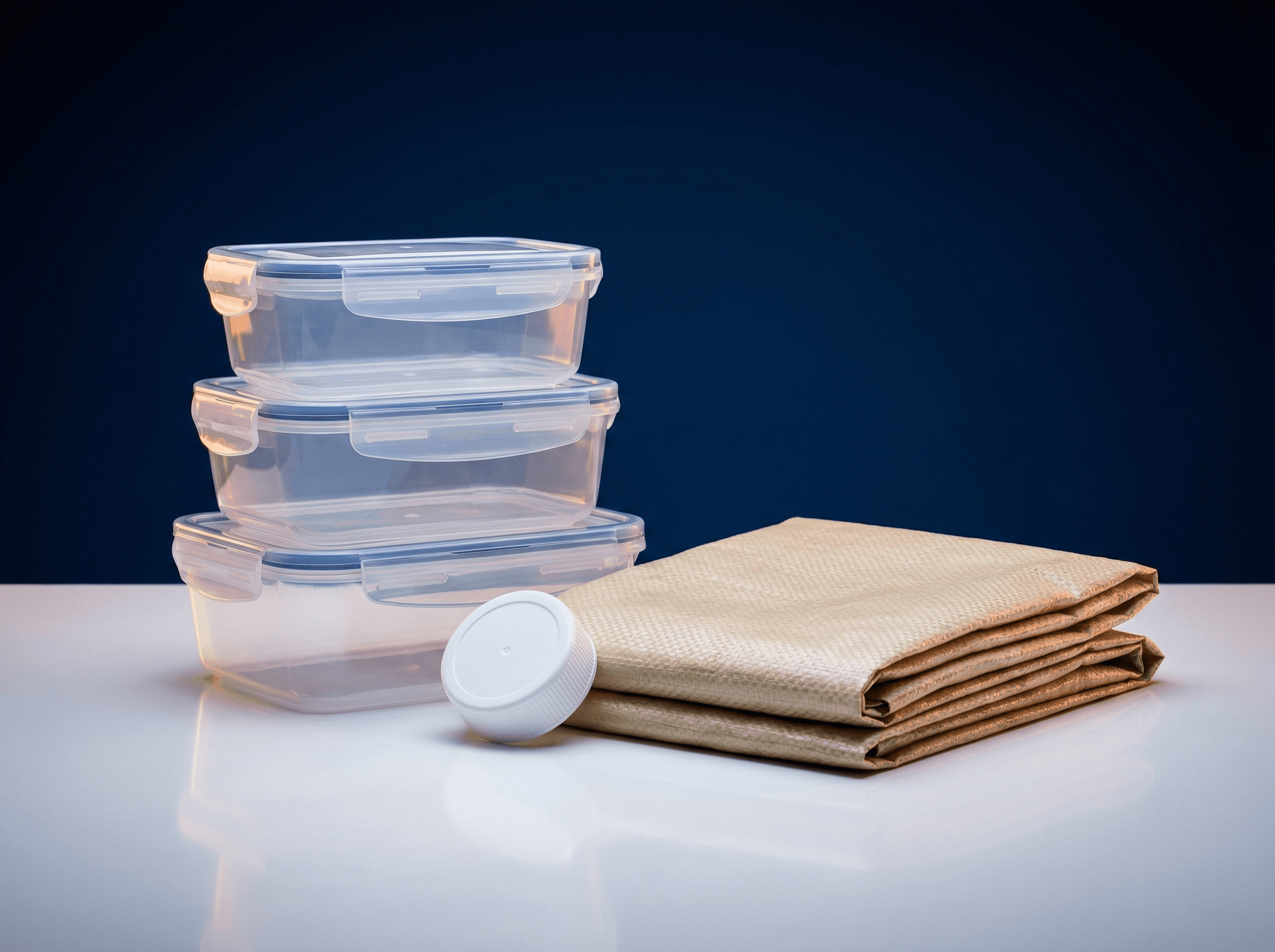
Polypropylene (PP) Resins
Polypropylene resin — homopolymer for BOPP, CPP, raffia, fiber and injection; random copolymer and PP-R pipe; and impact (block) copolymer. Grades from SCGC™, Oriental Energy, Sinopec and Hengli, with datasheets and fast quotes.
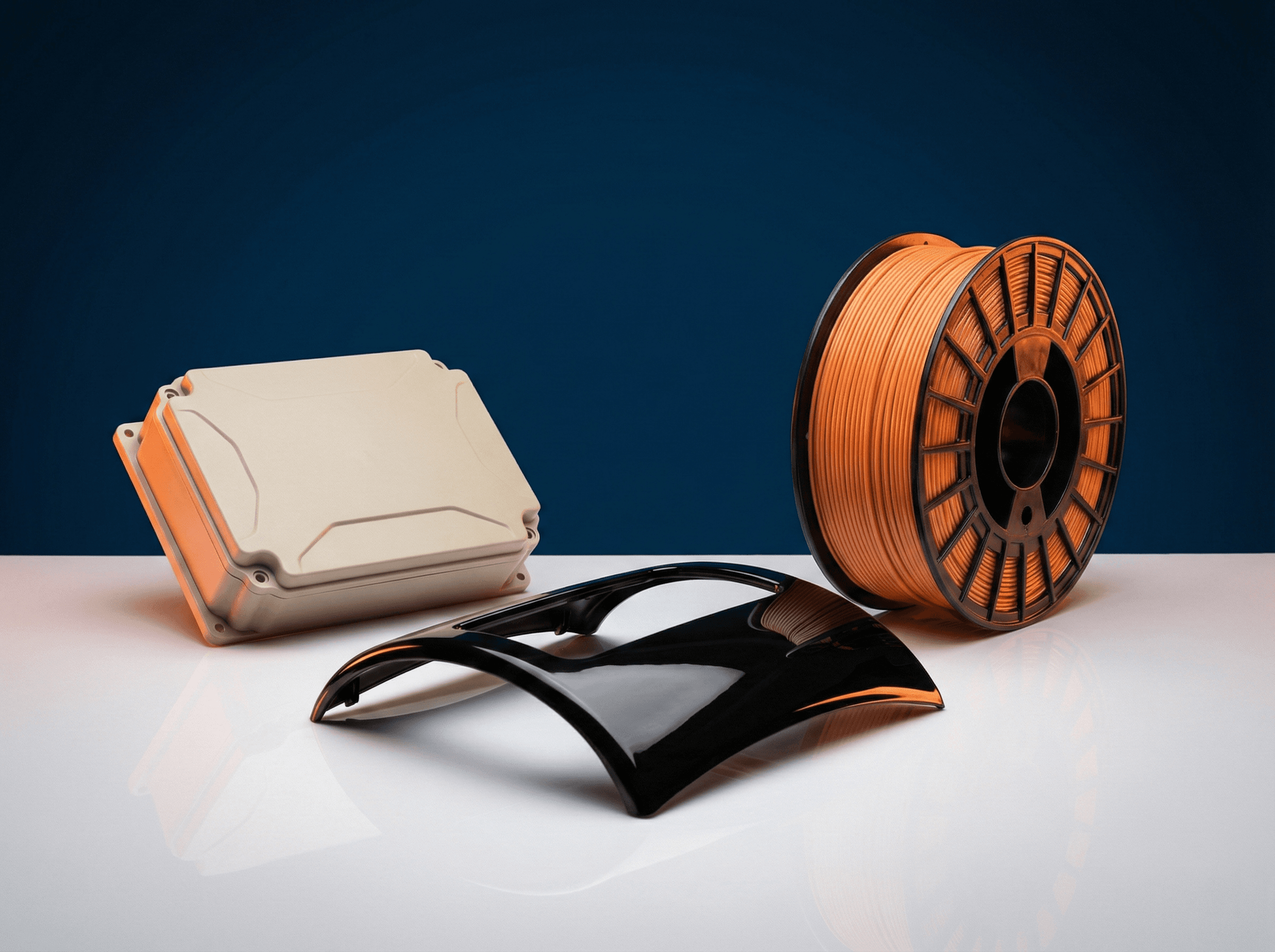
ABS - Acrylonitrile Butadiene Styrene
ABS resin is a tough, rigid amorphous thermoplastic combining impact strength, heat resistance, and easy processability. Available in general-purpose, high-impact, heat-resistant, and plating grades for automotive, electronics, and consumer goods applications.